In 1964, the Swiss theologian, Jean Rilliet, released a biography, Zwingli: Third Man of the Reformation (Philadelphia: Westminster, 1964). The volume was an attempt to reinstate the Reformer of Zurich among the leaders of the Continental Reformation after centuries in which he had been left standing in the shade. Zwingli’s premature death on the battlefield in 1531 (and rapid installation of the long-lived Heinrich Bullinger to be his successor) is but one of a range of factors that contributed to this neglect.
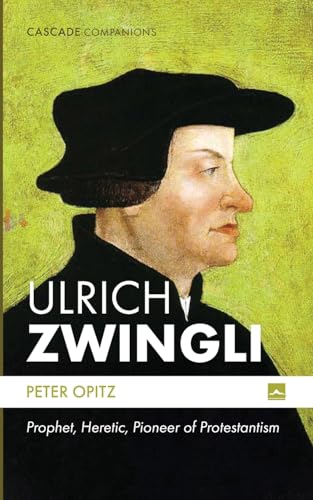
Happily, subsequent decades have seen modern biographies composed by G. R. Potter (Zwingli [Cambridge: Cambridge University Press, 1984]), Ulrich Gäbler (Huldrych Zwingli: Eine Einführung in sein Leben und sein Werk [Munich: Beck, 1983), and more recently, Bruce Gordon (Zwingli: God’s Armed Prophet [New Haven: Yale University Press, 2021], reviewed in Themelios 47.2). With these authors, Opitz means to call into question the adequacy of any designation such as “third man” for the Reformer of Zurich. In a short space, he depicts a Zwingli who was a contemporary of Luther, for a time a member of a circle of admirers of Erasmus and, while he lived, the preeminent non-Lutheran Continental Protestant leader.
Sadly, the complex reasons for the relative neglect of Zwingli are not explored in Opitz’s compact volume of 92 pages. As far as the English-speaking world goes, the neglect is rooted in choices made in early Victorian Britain. Calvin’s theological and biblical writings were taken up and reprinted in translation as ready tools in combatting the rise of a Rome-ward ritualism in the national churches of England and (later) Scotland. While an English translation of the German biography of Calvin was in circulation by 1849, no comparable English-language biography of Zwingli was available before 1900. That the better-known Calvin was known to dislike certain opinions of Zwingli compounded the question of his relative influence.
What Opitz does provide is a series of striking assertions about Zwingli’s unique role. The Reformation at Zurich was the first expression of what we call a “Magisterial” Reformation conducted under the authorization of an elected civic council rather than a solitary noble (pp. 42–43). The Zurich Reformation was the first in Europe to render the whole of the Scriptures into the vernacular language of the population (p. 51). This landmark was achieved by 1531, anticipating the completion of the entire Luther Bible by three years. Zurich, in Zwingli’s time, had in its “Hohe Schule” (founded after 1525) the first Reformed theological academy in Europe (p. 53). Zwingli was the first Continental Reformer to appeal to the King of France for toleration for that country’s persecuted Protestant minority. In this, he anticipated the effort of Calvin a full decade later (p. 66). Zwingli, in a career cut short in 1531, had still been the influencer (p. 86) of a whole range of younger Reformers (Bucer, Bullinger, Capito, Farel, Oecolampadius).
Opitz’s verdict, as one might expect after the narration of such “firsts,” is: “No theological idea voiced by Calvin had not already been discussed in the course of the Zwinglian Reformation. Both historically and theologically, Zwingli and not Calvin is the founding father of Reformed Protestantism” (p. 86). Opitz has not written a polemic as though to trample down an error, but he has, in brief compass, provided us with a revisionist portrait of a Protestant Reformer who has suffered undeserved neglect.
It can fairly be said that in doing so, Opitz has not sidestepped aspects of Zwingli’s career that are unflattering. We read that while a young priest, he was numbered with the many Catholic clergy who were promiscuous. We find that he was secretly married to a widow for an extended period in advance of the Zurich council’s approval of clerical marriage (p. 22). We read also of his familiarity with a Christian humanist circle at Zurich, some members of which opted for the radical path of Anabaptism; by doing so, they invited the prosecution and death which followed (pp. 27–34). The 1529 collision with Luther at Marburg is succinctly set out (pp. 68–72). The one aspect of Zwingli’s career that the reviewer expected to see addressed—and did not—was the Reformer’s aversion to the use of the arts—whether painting, metalworking, or music—in places devoted to the worship of God. Such excesses were only reconsidered in the time of his successor, Bullinger.
In 92 pages, the author has provided readers with an ideal introduction to this highly important first-generation Reformer of German Switzerland. We should put away the half-century-old designation, “third man.” He was, at the very least, of the first rank—with Luther.