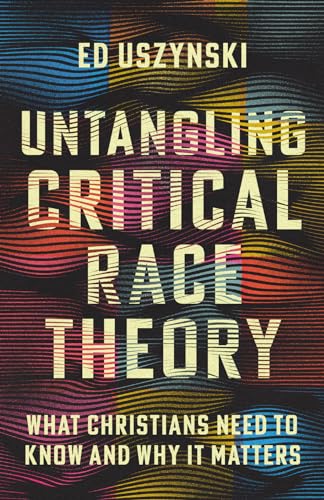
Untangling Critical Race Theory: What Christians Need to Know and Why It Matters is a much-needed addition to the growing field of Christian scholarship on Critical Theory (CT), Critical Race Theory (CRT), social justice, and “wokeness.” Untangling uses an academic approach unalloyed with a culture war agenda and, as such, is a primer on nuanced contextualized thinking and not a book for people seeking simple answers. In scope and structure, Uszynski’s book is most similar to Neil Shenvi and Pat Sawyer’s Critical Dilemma: The Rise of Critical Theories and Social Justice Ideology—Implications for the Church and Society; but in tone and disposition, his writing aligns more closely with Robert Chao Romero and Jeff M. Liou’s Christianity and Critical Race Theory: A Faithful and Constructive Conversation, and the various articles by Nathan Luis Cartegena. Uszynski rejects both the alarmist approach of such authors as Voddie T. Baucham, Jon Harris, and Owen Strachan, and the apologetics approach of Shenvi and Sawyer.
Uszynski’s approach grows from his years of cross-cultural ministry with Cru, his Trinity Evangelical Divinity School degrees, his PhD in American Culture Studies, and his interracial discipleship journey. Two premises frame the book’s narrative, which he says is specifically written for white evangelicals. The first is that despite sharing “familial characteristics,” Marxism, CT, and CRT are different theoretical frameworks that arose at different times to serve different purposes, and to critique them properly, we must first understand them. Uszynski chronologically outlines the historical moments that birthed each framework and explains the “why” behind their basic animating questions, setting his work apart from other authors who merely trace connections between ideas or blur the distinctions between the terms.
Second, the catalyzing moment for Uszynski’s thought on this subject came while reading Carl Henry’s 1947 classic, The Uneasy Conscience of Modern Fundamentalism. As noted by Uszynski, Henry asserted that “Social justice is not … simply an appendage to the evangelical message; it is an intrinsic part of the whole, without which the preaching of the gospel itself is truncated.” Furthermore, because so many churches use only individual evangelism to solve social problems, “younger evangelicals are unprepared to confront the socioeconomic crisis except through socialist ideology” (pp. 18–19). For Uszynski, the rising popularity of CT/CRT is the result of white evangelicalism not taking Henry’s warning to heart.
Uszynski explains that when CT/CRT scholars study how power is used and abused, to what ends, and by whom, they are asking the materialist’s version of Solomon’s guiding question in Ecclesiastes: “How do we make sense of life under the sun apart from God?” CRT asks “how race and power conspire to create structures and patterns that affect real lives” (p. 118). Their subject makes them natural allies with the disenfranchised and marginalized and leads them to take structural sin seriously, so their work functions as “an analysis of how sin works through the logic and processes of Capitalism and Conservatism” (p. 62). Uszynski’s use of “sin” is awkward since Marxists do not believe in sin or use the term. Still, by using this word, he is signaling that a robust doctrine of structural and systemic sin would lead a Christian to understand that this is, in fact, what Marxist-informed scholars are studying without realizing it.
In a professorial manner, Uszynski methodically unpacks the nuances of commonly mispresented concepts such as the social construction of race, wokeness, racism, intersectionality, white privilege, objectivity, white supremacy, whiteness, and social justice. He draws important distinctions between a theory and a worldview (denying that CRT alone is a worldview), explains the importance of Christians embracing both personal responsibility and systemic understandings of sin, and tackles such delicate topics as confessing corporate sin and explaining whether white people should apologize for being white. He strongly rebukes Christians’ rush to judgment of fellow believers who use specific terms without seeking to understand them or considering their context.
Uszynski argues that a Christian can learn from the analysis of CT/CRT scholars without feeling obligated to accept their radical progressive political solutions because identifying a problem and solving it are not the same thing. His overriding concern is that when evangelicals demonize CRT, they are ignoring the lived reality CRT is identifying and creating a theological lacuna that incentivizes people to either turn to radical politics or to various unorthodox liberation theologies (which he deems heretical). Where the social gospel and liberation theologies have flourished, he maintains, “Christians either failed to respond or responded so slowly to the plight of the marginalized, dispossessed, and neglected, that eventually someone felt the need to overcorrect” (p. 209). Hence, “the greatest threat to the strength of the church isn’t secular ideology; it’s the vacuum created by our own indifference toward social evil the Bible plainly condemns” and that CT/CRT exposes (p. 216).
Uszynski thinks Christians “shouldn’t need CRT” (p. 158) but astutely realizes that “We can know our Bible without ever having thought about why all the black kids sit together in the cafeteria” (p. 197). So he allows that “If your current reading of the Bible allows you to see how sin can become systematized and woven into social structures in an unrighteous and unjust way, then you don’t need CRT” (p. 160). This emphasis on structural and systemic sin aligns him with Romero and Lieu and distances him from Shenvi and Sawyer.
Besides the lack of an index, this reviewer was disappointed that Uszynski seems to confuse power and authority (pp. 70–74) and references ethnicity as “God-given” (unlike race) (pp. 97, 199), although it is also socially constructed. Arguably, Uszynski’s most controversial point is his assertion that people can accept the analysis of CRT but ignore the closely related critical theories about sex and gender. Although he asserts there is no reason we must accept them as a package, he neither acknowledges nor refutes the claims of many CRT and CRT-proximate scholars who emphatically argue for the interconnectedness of CRT with all other forms of oppression. He is clearly frustrated with evangelicals who view things differently than he does, and this occasionally manifests in a scolding or condescending tone toward his fellow white evangelicals. One such example is when he accuses them of embracing “near-hysterical” reactions to “any hint of what they call the oppressor/oppressed paradigm” (p. 176). A further friction point for some readers will be that he challenges evangelicals not to worry about embracing the terminology of CRT as long as their motivations stem from a proper reading of Scripture. However, his failure to employ his theological training to exegete illustrative Bible passages was a missed opportunity.
Ultimately, Uszynski’s point is that forward movement on the racial challenges facing evangelicals will only come from thoughtful, honest, biblical teaching about all forms of sin, and CRT can help white evangelicals better understand forms of systemic and structural sin they would otherwise tend to overlook. The perspectives in this book can be a gift to white evangelicals … if they will receive them.