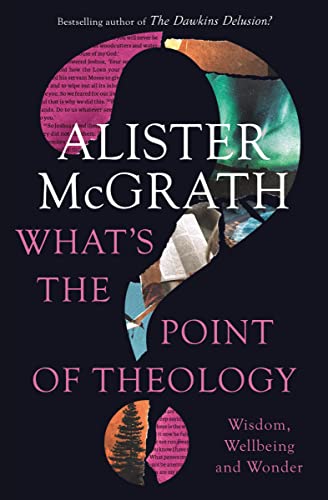
Alister McGrath is stranger to no topic in systematic theology. His many publications range from popular introductory texts to scholarly, academic works on all theological loci. His voice is valued in numerous and varied theological circles, yet he is also respected in today’s public square—a venue that is often hostile to the kind of biblically faithful expression of Christianity that characterizes McGrath’s writing. This position of theological authority and cultural responsibility uniquely qualifies him to tackle the content of his new book, What’s the Point of Theology?
Recent decades have produced a refreshingly abundant number of books on theological method and theological prioritization. This is a positive step beyond the necessary but limited discussions about prolegomena in the early chapters of larger works in systematics. But all these efforts bespeak a goal that drives or should be driving, the theological project. Many resources today lack the robust and winsome focus on the precise purpose that McGrath so clearly articulates in these pages.
Part 1 of the book lays the groundwork for his expression of the point of theology by describing the discipline as a way of seeing the big picture of God’s story (chs. 1–2), and then helpfully responding to five current and relevant criticisms of theology (ch. 3). Part 2 is the three-chambered heart of the project, claiming that the point of theology is: to lead us to wisdom that draws from the riches of the Christian tradition (ch. 4), to expose us to the truth of the meaning and value of our lives (ch. 5), and to foster a deeper sense of wonder about the mysteries of the divine (ch. 6). By understanding theology’s three-fold point, we understand why it matters and what it ultimately leads to.
McGrath succinctly sums up theology’s point claiming, “Theology matters because Christianity matters and theology aims to preserve, express, and convey its essence” (p. 130). Elsewhere he expands,
Theology thus captures and puts into words the moral, intellectual and spiritual vision that is the heartbeat of the Christian faith—a way of seeing things that delights and overwhelms us and leads us to worship and adoration rather than mere understanding. It wrestles with the question of how Christians can hope to express this defining and compelling vision in words. It helps us to explain what Christianity is fundamentally about and enables us to convey the difference that such an understanding makes to the way in which we comprehend our world and live within it. (p. 9)
In addition to the aforementioned positive contribution of a book-length treatment on theology’s aim and end, McGrath services the church by writing in an accessible form for both pastors and laypeople, rather than merely for those in the academy. At several places throughout the book, he specifically addresses how a grasp of theology’s point emboldens and gives direction to the preaching of God’s Word, as well as other ways in which God’s people communicate His truth to this world.
Early in the book, McGrath criticizes certain academic theologians who are so overly specialized that they become inaccessible to many of the people that theologians should serve. An aspect of his criticism is that such academic theologians are often “engaging with writers that few have ever heard of” (p. 43). A cursory perusal of the book’s endnotes reveals that McGrath would be considered guilty of his own critique if it were a legitimate critique in the first place. But given the historically and academically reflective nature of Christian theology—historical and academic reflection that characterizes so much of McGrath’s work in other areas—I think we can be thankful that he exposes readers of this book to a wide array of authors, and merely mistakes this feature of theology for a bug in the system.
When I finished reading What’s the Point of Theology? I jotted down a summary that I have returned to several times since. I believe it accurately reflects the truth about theology’s aim and the core of what McGrath is communicating to us: for the public, theology is informative; for the individual Christian, theology is reflective; and for the corporate Christian church, theology is visionary.
Reading this book will keep your theological fire ablaze, rekindle it if it has started to die, or maybe even ignite it if you’ve never engaged in theological thinking before.