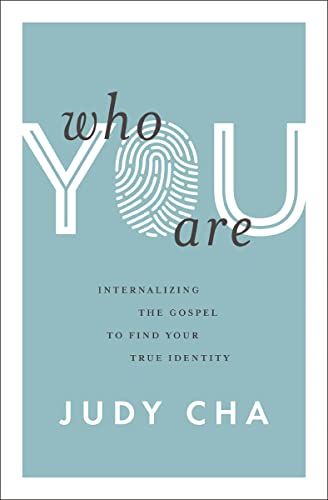
For those looking to understand how God’s grace connects to our internalized shame, core hurts, and personal identity, Dr. Judy Cha’s book, Who You Are, is an excellent guide. Dr. Cha serves as the director of Redeemer Counseling Services (RCS), a ministry of Redeemer Presbyterian Church in New York City. She is a licensed marriage and family therapist who studied at Westminster Theological Seminary and has worked at RCS for over twenty years. During that time, Dr Cha and her team have developed a counseling model called the “Gospel-Centered Integrative Framework for Therapy (GIFT).” This framework seeks to “bring the best of biblical and clinical insights to the practice of counseling.” In so doing, it “provides a way of defining what is wrong and shows how we can contextualize the solution to best help people experience the gospel and lasting heart change” (p. xvii).
The book is clearly laid out in three parts that progress logically. Part 1 asks, What is wrong with us? Because every counseling system presupposes an anthropology (and a pathology), in these chapters Cha explains what she thinks our real problem is. She argues that “our problem begins with our innate propensity toward the idol of self by creating our own system of self-redemption (SOSR)” (p. 8). While Cha believes the Bible teaches that our problem includes personal sin, spiritual weakness, woundedness, and spiritual warfare, the SOSR concept “is the way we capture the impact of sin comprehensively” (p. 9). As the way someone’s SOSR operates is best understood in the context of their life story, Cha helpfully illustrates this with fictional case studies as well as her personal life story.
If the ultimate problem is idolatry, then the ultimate solution is found in the gospel. Cha summarizes the central role of the gospel in the GIFT approach as follows:
Internalizing the gospel leads us to progressively relinquish our SOSR.… Since the gospel reconciles us to God, we are able to face him, and he becomes our source of derived identity. As a result, our view of self is progressively transformed as we internalize who God says we are. We are, in fact, not afraid to see our brokenness because we also see who we are in Christ and all that he has done for us. (pp. 12–13)
Having laid that foundational assessment of our deepest problem and ultimate solution, the book then proceeds to look at these elements in more detail. Chapters 2–4 unpack the relationship between identity, shame, core hurts from past experiences, and the idolatrous strategies we employ to assert an identity apart from God.
Part 2 of the book, chapters 5–7, explores how we can internalize the gospel. Two key aspects of internalizing the gospel that stood out for me were the role that relationships and imagination played. Regarding relationships, Cha argues that “the relational wounds that shaped our views of God need new relational experiences in order to change our views of God” (p. 83). Regarding the imagination, Cha says that because we know Christ from Scripture, “it is possible for us to imagine how he would interact with us” (p. 114). Using our imagination in this way is meant to facilitate prayer and relational engagement with the Lord.
Part 3 of the book, chapters 8–10, is even more practical as Cha explains how we can ever more deeply internalize the gospel. We do this by looking at ourselves and knowing our story (ch. 8), and by connecting with others through practicing vulnerability and listening (ch. 9). Finally, in chapter 10, Cha explains that we can connect with God more deeply by minimizing the barriers that prevent us from making these relational connections with him, and proactively creating positive emotional connections to him through using our imaginations, through worship, and through our physical senses.
In her conclusion, Cha writes these profound words:
To internalize the gospel is to deepen our relationship with God. They are one and the same. What we know about God should become a lived experience for us, in which God is not just a belief but a person.… As our relationship with God deepens, our preoccupation with ourselves will lessen. In fact, we will begin to experience greater self-acceptance, knowing we are broken and yet dearly loved.” (p. 190)
I think this is a significant book. By clearly explaining RCS’s counseling approach in simple and clear terms, Who You Are offers a wonderful contribution to the church at large, and to the field of Christian counseling in particular. While being technical at times, the book is accessible to the average church member and could be read in pairs or small groups. At a more academic level, this book offers several contributions to the field of Christian counseling. For example, Cha’s theological reflection on the dynamics of idolatry, based on Keller’s work in Counterfeit Gods, is remarkably insightful in showing how personal idolatry functions as a system of self-redemption (SOSR). The SOSR helps us see how our story, our view of self, and our emotions and behaviors, all connect to a pattern of idolatry.
There are two significant theological issues raised by the book, however. The first has to do with the weight Cha gives to the problem of shame. “Shame is the problem behind every problem.… I’ve often referred to the problem of shame as the universal pathology of all humanity” (p. 23). While I do think shame is a big problem for all of us—and in the GIFT model, an awareness of shame is a great strength—I am not convinced that shame is best described as the problem beneath all our other problems. One aspect of biblical thought that Cha might have explored further is how our idolatry brings us under God’s wrath, and how the cross deals with our inherited and chosen rebellion against God. To be fair to Cha, she is not seeking to diminish the role personal sin plays in what goes wrong with us. In fact, this book contains an excellent analysis of both surface idols and deep idols (p. 59). But these comments left me unclear as to whether Cha is arguing for something more significant regarding the relationship between shame, idolatry, and our wayward hearts.
The second theological issue the book raises concerns the larger project of blending clinical insights with biblical truths. The RCS approach overtly seeks to integrate theology with psychology—and is a good example of how to do it well. But certain psychological categories seemed to need deeper reflection. I’ll cite just one example: the concept of a Corrective Relational Experience (CRE). While I readily acknowledge the importance of gracious relational experiences as a key element in our sanctification, I wondered what else Scripture might say to those who experience ongoing relational disappointments. This is perhaps where a concept like CRE could be developed (or even reformulated) with more theological detail.
Having said that, I conclude by emphasizing the book’s value. Cha has clearly communicated the RCS GIFT approach in a way that can be applied to the reader’s life. Who You Are combines compassion for shame-laden saints while encouraging a deep look at our struggles with idolatry. While some counseling models focus only on sin, or only on suffering, or only on shame, the GIFT approach is multifaceted. Both vocational counselors and everyday Christians will benefit from a careful and personal reading of this book. Written with kindness and informed by years of counseling, Who You Are provides a valuable roadmap for internalizing the gospel.