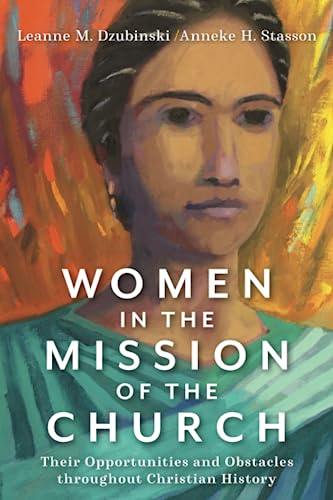
This is a most welcome, thematic and historical survey of a very contemporary topic in church and mission history, which also crosses over into practical ministry studies. It adds strength to books written over the last forty years related in some way to this theme, including Ruth A. Tucker and Walter Liefield, Daughters of the Church: Women and Ministry from New Testament Times to the Present (Grand Rapids: Zondervan, 1987); Ruth A. Tucker, Guardians of the Great Commission: The Story of Women in Modern Missions (Grand Rapids: Zondervan, 1988); and Dana L. Robert, American Women in Mission: A Social History of their Thought and Practice, The Modern Mission Era, 1792–1992 (Macon, GA: Mercer University Press, 1997). Gina A. Zurlo’s Women in World Christianity: Building and Sustaining a Global Movement (Wiley Blackwell, 2023) is a recent, major contribution.
One strength of Dzubinski and Stasson’s book is the bibliography (pp. 215–32), which cites approximately 300 works. There is much here for further historical study as well as for study related to modern gender studies of Christian women. I suspect this will be a benchmark bibliography for some time. When sifting through the bibliography, readers will note that the New Testament and several periods of church history are covered—the latter much more extensively.
If one views church history from a wider lens than mere historical theology, then women have not been given much space in church history lectures; then again, not many people who have served in ordinary fashion, regardless of gender, have been included. Anyone who teaches church history with a wider lens should consider the inclusion of lesser-known voices. This book does force those who teach church history to reflect upon their craft as teachers and writers. Such reflection will help evaluate whether women have been properly included in their stories and seek a truthful telling of the historical Christian narratives, achievements, and problems.
Dzubinski completed her PhD at the University of Georgia in 2013—her dissertation being later published as Playing by the Rules: How Women Lead in Evangelical Mission Organizations, American Society of Missiology Monograph 52 (Eugene, OR: Pickwick, 2021)—and her DMin at Gordon-Conwell Theological Seminary (“The Work Practices of Women Missionaries”), and she served seventeen years with Greater Europe Mission. As for Stasson, she is an associate professor of humanities and history at Indiana Wesleyan University and the author of Walter and Ingrid Trobisch and the Globalization of Modern Christian Sexual Ethics (Eugene, OR: Pickwick, 2021).
The book is organized chronologically: part 1, “Women’s Leadership in the Early Church” (the shortest, with two chapters); part 2, “Women’s Leadership in Late Antiquity and the Middle Ages” (three chapters); and part 3, “Women’s Leadership Since the Reformation” (four chapters). One small quibble: the book’s title seems to indicate that this book is about the involvement of women in “mission”; but the authors frame these parts in terms of “leadership.” Some readers may find this surprising. The three parts provide a good framework for a fast-paced survey, yet one with several subheadings included along the way. The “sub-themes” of opportunities and obstacles are woven throughout, creating a unity of presentation and study. However, I think the sub-themes could be applied much more broadly to other studies as they are not exclusive.
The authors have amassed a large number of individual women and movements of women within the history of Christianity. (I suspect it would be a revealing exercise in many church history classes to see how many of these are familiar to the students.) I do not think this book should be seen as the final word but as a survey that is easy to read and well-organised and will undoubtedly enlighten many readers. The book has received two society awards to date.
Like all such surveys, there are gaps (and necessary choices of exclusion) in this work, yet the framework will force others to take up the challenge to continue the research. For example, I would have liked to see a section on Christian women of the modern period and their mission in opposition to abortion. Also, as an evangelical Presbyterian, I found the book did not engage with my history. Still, its general and helpful engagement with the topic was sufficient rouse my interest in the book. The history of deaconesses was a helpful contribution. I was particularly drawn to the final three chapters. I have had to explain “Bible Women” to groups countless times when delivering mission talks, so I was delighted to see this topic included in chapter eight.
There are tensions and divides when it comes to mission and the leadership of women. This is the reality within evangelicalism concerning egalitarianism and complementarianism (and within each of these, there is also much diversity of understanding, interpretation, and application). Further, not all will feel that ecclesiology and church polity have been sufficiently explored. However, this should not prevent us from taking up this book, learning our history, and entering into a well-informed discussion and engagement on the subject.