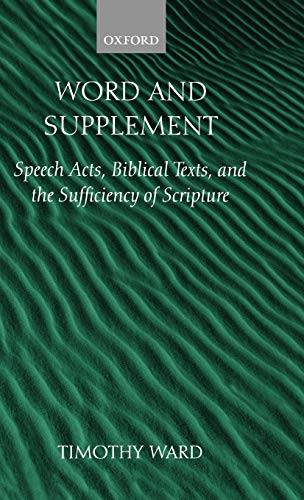

This is a profound and faithful contemporary articulation of the classical doctrine of Scripture. For ward, this doctrine can be confessed too cheaply and denied too hastily. Thus the book has two intended audiences proponents of the classical doctrine who merely repeat past formulations, and contemporary theologians who are broadly orthodox but who dislike the classical view.
Ward essays a ‘critical retrieval’ of the classical view by talking theological advantage of the ‘linguistic turn’ in philosophy and other issues in hermeneutical theory. He offers historical and theological reasons for the choice of ‘sufficiency’ as the key attribute to be considered but probably the key reason is methodological: it sets up a dialogue with contemporary theory as it raises issues to do with a text’s ontic and functional aspects. In other words, does a text need to be supplemented by authors, readers, hearers, or is it in some way sufficient? And if the text is the biblical text, does it need to be supplemented by the Spirit and textual, canonical, historical and cultural contexts?
The first main chapter undertakes a historical survey of the sufficiency of Scripture and this reveals three aspects of the doctrine: divine speech, the text, and the canon. Each of these three areas is then ‘reconstructed in dialogue with a variety of contemporary views, both theological and hermeneutical’. These three chapters form the constructive heart of the book and involve Ward in engaging with a staggering array of conversation partners: on divine speech, we have Austin, Searle, Wolterstorff and Barth; on the text, we meet (among many others) Frei, Hirsch, Derrida, Gadamer, Fish; and on the canon, primarily Childs and Warfield. Key for these chapters is Ward’s approach to the material and formal aspects of Scripture. Materially, Scripture provides sufficient knowledge for salvation and the chapter on text constructs an approach to texts as sufficient; formally, Scripture is sufficient for its own interpretation and so the chapter on canon constructs an approach to a collection of texts as sufficient.
There are many excellent strengths to Word and Supplement. It offers a robust account through speech-act theory of how Scripture may be permanently identified with the Word of God, as well as a clear theological pathway through many postmodern and basically atheistic approaches to texts. However, two things in particular stood out for this reviewer.
First, although Ward does not explicitly spell this out, it could be argued that the figure of Barth looms significantly behind much of the contemporary theology which Ward describes as being orthodox while nevertheless wanting to reject the classical doctrine of Scripture. In this way, the criticism of Barth here is strategic and deserves to be heard in the academy. Ward offers a significant way of addressing Barth’s concerns while also being faithful to the classical view of the Bible.
Second, Ward methodologically locates implication as a central tenet of his overall argument. Both Wolterstorff’s ‘double-agency discourse’ and Childs’ final-form and intercanonical interpretation are criticised rightly for their epistemic instability precisely because they lack a rigorous account of inspiration. Ward insists that inspiration cannot be regarded as a mere ‘supplement’ to other ways of explaining God’s relationship to the Bible and his argument provides a marvellous integration of theological concerns which are usually rent asunder in modern theology’s frantic desire to avoid ‘biblicism’ or ‘bibliolatry’.
Perhaps because the terrain covered by Ward is so vast and the fields often so highly specialised more learned readers may find the treatment a bit thin on their area of expertise. This, however, must not be allowed to detract from the force of Ward’s overall thesis and this is certainly the best contemporary evangelical treatment of Scripture of which I am aware.
David Gibson is the Minister of Trinity Church, Aberdeen, Scotland. He is author of Reading the Decree (T&T Clark, 2009) and co-editor of From Heaven
He Came and Sought Her (Crossway, 2013).