Do you believe that it is possible to deny the good deposit by our deeds, to contradict the gospel at the level of church culture, and to unsay with our works what we say with our words?
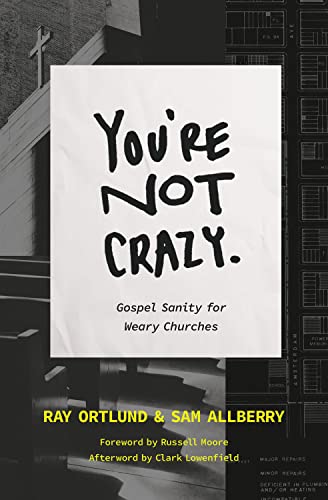
Ray Ortlund and Sam Allberry, co-authors of You’re Not Crazy: Gospel Sanity for Weary Churches, do. They know it is possible from personal, pastoral, and at-times painful experience.
To put the same “not-crazy” conviction at the heart of this book positively, consider these claims:
- “a church’s culture always reveals whatever the people most deeply believe” (p. xvii)
- “the beauty of Christ” should “shape every aspect of our churches” (pp. xvii–xviii); and
- the category of faithfulness demands “gospel doctrine creating gospel culture” (p. xviii).
The message of You’re Not Crazy is that gospel doctrine and gospel culture belong together. They must, insist the authors, for both the truth and beauty of Christ to shine in and through his people.
The book began as a Crossway-supported podcast, launched in late 2021 while the world (and the church) was still trying to make sense of life during the COVID-19 pandemic. It was Ortlund, seasoned pastor to pastors at Immanuel Nashville, who was first approached by The Gospel Coalition to host a podcast for younger pastors. Ortlund teamed up with Allberry (associate pastor at Immanuel), and so the gospel culture conversations began.
Interestingly, while the subtitle to the podcast started out as “Gospel Sanity for Young Pastors,” it soon became apparent that it wasn’t just younger pastors who were listening and benefitting. The subtitle for the book, Gospel Sanity for Weary Churches, reflects a further expansion of the intended audience.
This is a book for every believer who refuses to settle for sub-Christian life together. Gospel culture creates Christlike communities that are truly beautiful and beautifully true. It is brief and accessible enough to be placed in the hands of either a church ministry team or an interested lay person.
After a foreword written by Russell Moore and an introduction from the authors, the opening chapter (“What Is Gospel Culture, and Why Does It Matter?”) defines and provides a biblical basis for the concept of “gospel culture.” Ortlund and Allberry lay out three convictions and three key passages to make the case for why our gospel convictions must be expressed and embodied in our common life. The third conviction—that “gospel doctrine creates gospel culture” (p. 7)—is explained as follows:
When the gospel is taught clearly, and when the people of a church believe it deeply, it does more than renew us personally. The doctrine of grace also creates a culture of grace. In such a church, the gospel is both articulated at the obvious level of doctrine and embodied at the subtle level of vibe, ethos, feel, relationships, and community. (p. 7)
The following six chapters “(broadly) follow an order of service,” with the aim of helping us think about “how we might try to reflect the beautifying impact of the gospel from our opening welcome to the way we’re sent out at the service’s end” (p. xviii). While both Ortlund and Allberry now have Anglican affiliations, the book is pitched to Reformed evangelical readers from a range of denominational and liturgical backgrounds.
In chapter 2 (“Open the Doors, Open Your Heart”), the authors return to Romans 15:7 (“Therefore welcome one another as Christ has welcomed you, for the glory of God”) to establish a culture of gospel welcome. In one of the pair’s many pithy sayings, “The finished work of Christ on the cross is not God’s way of saying to us, ‘You’re free to go now’ but ‘You’re free to come now.’ He’s not sending us off but inviting us in” (p. 25).
Chapter 3 (“Come into the Light”) encourages churches to develop a culture of gospel honesty, marked by deep, robust confession. In chapter 4 (“See the Glory”), the authors model outdoing one another in cultivating a culture of gospel honor. This includes a deeply moving transcript of a phone call with an older saint that Ray and Sam were seeking to honor.
Chapter 5 (“Let Christ Preach”) focuses on platforming a culture of gospel invitation in our preaching. Chapter 6 (“Leave Behind LordItOver Leadership”) calls for a culture guided by gentle shepherds. And chapter 7 (“Make Your Church’s Love Obvious”) lifts our eyes to esteem a culture fueled by renewal and mission.
Each chapter is well-structured, peppered with helpful subheadings; closes with discussion questions; and is capped off with a relevant excerpt from one of Ray and Sam’s conversations. For those of us familiar with the podcast, it is impossible not to hear their voices and feel their warmth for one another throughout the book.
You’re Not Crazy has much to commend it. While the main thrust is convictional, the tone is pastoral—from start to finish, you know you are in the company of friends. The book is also devoid of data-driven, outcomes-based ministry philosophy. For some the lack of focus on results may frustrate; for others, like me, it liberates and relieves. Readers, like the authors, may be struck by “how full the category of faithfulness really is” (p. xviii, emphasis original). Preachers and Bible teachers will also appreciate the general and Scripture indexes at the end.
A book this readable and concise inevitably has some gaps and aspects that would benefit from further development. For example, where else outside of the select range of biblical texts cited do we find evidence of gospel culture in the Scriptures? Likewise, is the concept of culture a twenty-first century buzzword, or is it a category we can expect to encounter throughout church history, even if it goes by other names? Again, despite the worthy focus on local churches, what might it look like to cultivate gospel culture in other spheres—whether at the personal level, in the household, or within leadership teams? Finally, what might it look like to seek to recuperate or revive gospel culture where conflict is present or where the gospel has been absent?
Later episodes of the podcast address some of these questions. But as it stands, You’re Not Crazy has been transformative for my wife (Bec) and me in our life and ministry. It has impacted the shape of our Sunday services, from the opening welcome to the way we do our notices. We have built gospel culture terminology into our parish vision and mission. I have led devotions with a visiting mission team based around standout chapters in the book. Most importantly, Ray and Sam have helped us to love Christ more, in all his truth and beauty, and to better prize the gospel and the culture it creates in our personal faith, family home, and public ministry.
In the book’s foreword, Ortlund and Allberry are commended as “a couple of trusted friends” who will come alongside you and say, “You’re not crazy; we see it too. You’re not imagining how hard it is. And you’re not wrong about how overwhelming it is. But here’s what we’ve found, and here’s how you can find it too” (pp. xiii–ix). It was our prayer to share the gospel and our lives with people in places that others might miss that first gave Bec and me the crazy notion of taking our family into full-time vocational ministry in all sorts of far out places. It is the kind of convictions and exhortations contained in this book that have the power to keep us here.