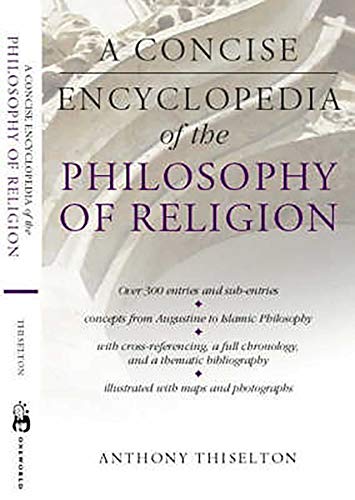
This is a popular reference work, written with the student in mind. For this reason, the entries in the book are brief but informative, written in clear, concise prose. References to the literature on a particular topic are contained in the body of the articles, and cross-references are picked out in upper case text. For those who come to a topic or author wondering where they fir into he grand scheme of things, there is also a short chronological chart at the back, and an index of names. All of which make it a very user-friendly single volume reference work, particularly to undergraduates who are struggling for straightforward introductions to what are often complex debates in the philosophy of religion.
Reviewers of such books tend to point out entries that have been omitted, but which they think should have been included in a work of this nature. Sometimes this can seem a little churlish, after all, a popular encyclopedia does not claim to be exhaustive, only informative, albeit about a certain, circumscribed range of problems, concepts and issues in the field. That said, there are entries that perhaps should have been in this volume, but were not. Here are a few of them, in no particular order: Jonathan Edwards, perfect being theology, common-sense philosophy (or perhaps, Thomas Reid), Phenomenalism, something on the contribution of Reformation Theology, (there is an article on natural theology, but no separate articles on any of the Magisterial Reformers themselves), and naturalism. This last example is a particularly interesting omission, since it seems to be such an important issue in contemporary philosophy of science at the interface with philosophy of religion and Christian theology (see, for example, work by Alvin Plantinga and J.P. Moreland to name just two recent Christian philosophers who have dealt with this issue).
It might also have been of more use to have had more indices (of notions and/or subjects), and perhaps a chronology which placed some of the issues and persons referred to in a broader context, especially if this is a volume directed towards undergraduates.
There are, however, considerable strengths in this book. For example, there are a good number of entries on medieval philosophy and theology (particularly Islamic and Eastern philosophies, which is good to see). There are also a number of entries on standard issues in philosophy of religion, like arguments for and against the existence of God, religious language and its problems, logical positivism and the legacy of mid century analytic philosophy. There are also a useful group of articles on nineteenth and twentieth century continental theologians and philosophers, which will be of use to undergraduate theologians. There are even articles on basics in philosophical logic. The coverage of concepts in contemporary philosophy of religion is also good (evil, prayer, religious experience, postmodernity, attributes of God, ethics, creation and others).
I would certainly recommend this to undergraduate theologians and those taking philosophy of religion courses. I am not aware of another reference words like this one, that covers the material it does in the format offered, to a student audience. It should be a useful tool for earnest student and a crib for harassed teachers.
One quibble: it might have been better if the cover of the book had had a stronger image. Other similar reference works (The Blackwell Companion to Philosophy of Religion, for instance) are far more attractive in this respect than the Concise Encyclopedia.