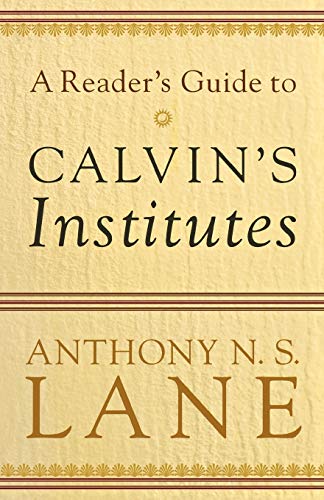
With the celebration of John Calvin’s five hundredth birthday in 2009, numerous publications have commemorated the life and thought of the great Genevan reformer. An extremely helpful addition to the growing Calviniana is Anthony N. S. Lane’s A Reader’s Guide to Calvin’s Institutes. Lane has produced a relatively brief aid for the potentially overwhelmed reader of what is arguably Calvin’s magnum opus.
Lane’s contribution is not the only summary of the Institutes ever written. One could say that there has been a cottage industry of sorts in this area. Even in Calvin’s own lifetime, various authors provided condensations. One of the more recent analyses of the Institutes was authored by Ford Lewis Battles, translator of the most commonly used McNeill/Battles edition of the Institutes, upon which Lane’s Guide is based.
The author provides helpful instruction in how to use his Guide (pp. 9–10) and follows that with a chapter on John Calvin and the history and purpose of the Institutes (pp. 11–22). The book proper follows the order of the four books of the Institutes and divides up the material into thirty-two readings. These readings focus on Calvin’s positive theology, and the readings average eighteen pages in length. The author provides an overview of the whole reading schedule in the book’s only appendix (pp. 173–74). Lane explains,
The Institutes is divided into thirty-two portions, in addition to Calvin’s introductory material. From each of these an average of some eighteen pages has been selected to be read. These selections are designed to cover the whole range of the Institutes, to cover all of Calvin’s positive theology, while missing most of his polemics against his opponents and most of the historical material. My notes concentrate on the sections chosen for reading but also contain brief summaries of the other material (9–10).
Lane offers pithy summations of each of the sections of each chapter of each book, focusing, as he notes in the citation given above, on the positive theology of the Institutes. This is an excellent aid to comprehension of Calvin. It is not a replacement, however, for the Institutes themselves, but an aid to understanding a theological masterpiece.