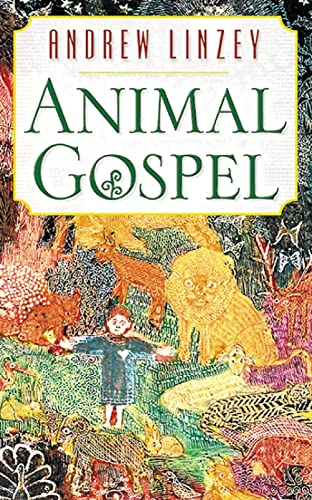
The sub-title to this book is Christian Faith as though Animals Mattered and Linzey claims to be writing an ‘inspirational’ and ‘pastoral, evangelical sequel’ to his weightier Animal Theology (SCM, 1994)(6). This reviewer has not read the latter and so perhaps approaches the work as the publishers intended.
The book is presented in two sections: the first looking at the neglect of animals in Christian teaching and proposing theological correction by attention to overlooked doctrines; the second looking at the current treatment of animals that ‘from the stand-point of the Gospel’ are ‘unenlightened’, concluding with two chapters laying down a way forward for society and the church.
Linzey affirms in his introductory ‘confession’: ‘I see in the face of the Crucified the faces of all innocent, suffering creatures’. He appeals to the insight (if that is what it is) of John Henry Newman, reflecting on Jesus Christ as the Lamb of God, to ground his assertion that ‘Animal suffering represents nothing less than the innocent, undeserved suffering of Christ’ (16, 73 ff.). But we might ask what could possibly be meant by representation, and then, should we receive satisfaction, ask what the morally significant factor in that representation might be (creatureliness? moral?) innocence? Are we not really looking at the results of an inadequate Christology? Interestingly Linzey quotes Barth: ‘Tell me how it stands with your Christology, and I shall tell you who you are’ (20)!). It is far from clear that all suffering is necessarily Christ-like, and inasmuch as Linzey draws on this inference for understanding animal suffering, we are left not only questioning his presuppositions but also the validity of his conclusions as conclusions. We are certainly not presented any sustained argument to lead us to support the author’s assertion; and whether or not we agree with his emotive suggestion that ‘no theology that desensitises us to suffering can possibly be Christian theology’ is simply not to the point.
We regret the apparent premise of this ‘pastoral’ book: that populist appeal obviates the need for serious argument and so settles for assertion. The reader need not doubt authorial sincerity but must protest if ‘sincere’ were to be insinuated as synonymous with ‘pastoral’ (or is all sincerity Christ-like sincerity?). If anything it is of paramount pastoral importance that a voice that would speak Christianly should do so with the greatest achievable clarity of reasoning. This would, after all, follow from the conviction that to speak Christianly and pastorally one must speak evangelically, and our ‘evangel’ is clearly given and so should be clearly testified to. Certainly we would agree with Linzey that ‘Ethics cannot be divorced from theological vision’ (18). So we have in this book a prime exemplar of this general methodological axiom divorced from a seriousness of submission to the gospel as given. We encounter throughout a liberationist’s God of preferential options, a theological vision this review cannot engage with but might expect to warrant some justification in a work, however basic, of theological ethics.
This need not gainsay the practical wisdom of much that Linzey writes, or the penetrating and often, but not always, negatively critical analysis of the church’s attitude to animal welfare, as well as those excesses of animal liberationists and animal worshippers. Nevertheless, evangelical Christians must be clear in their gospel thinking if they are to call it such. Consensus on polemical concerns or practicalities can mask a failure to engage with crucially different methodologies and even draw the reader into answering questions or defending positions that do not validly exist in the light of the gospel.
Serious evangelical thinking on the moral regard accorded to animals is required, not solely by current concerns but by the gospel call to, and permission of, human action in the world. Animal Gospel is not it, and as to Linzey’s claim to write a book that is both ‘pastoral’ and ‘evangelical’ we must conclude that, having failed to produce the latter, he cannot be commended as having produced the former. Despite doubts about the usefulness of the weightier tome this work accompanies we would recommend borrowing that rather than buying this.