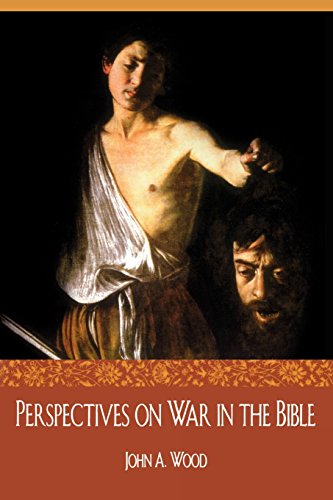
Hailed as ‘a comprehensive study of varying traditions of war in the Bible’, this book contends that it is possible to uncover a variety of views regarding warfare. Using traditional categories, Wood argues that the Bible has passages which support ‘holy war’, others which favour ‘just war’, and still others which advocated ‘pacifism’. Furthermore, even within these broader categories different approaches may be observed. Thus, according to Wood, the Bible does not present a unified approach to the subject of war.
Although Wood is correct in his observation that the biblical material reflects a variety of outlooks on war, his overall analysis of the evidence is disappointing. In line with much modern scholarship, he assumes that the presence of differing viewpoints within the Bible is due to different traditions, already present within the community of faith, being incorporated into the biblical texts during the process of composition. All of these traditions managed to be included in the biblical writings, in spite of the fact that some of them are mutually exclusive.
While Wood’s study is helpful in drawing attention to the different views of war in the Bible, he fails to analyse sufficiently the contexts in which these occur. Thus, for example, a survey of the OT material reveals that the Israelites were to adopt a different attitude towards the nations within the land of Canaan and those outside. Not only are such factors crucial for understanding why various viewpoints on war exist within the Bible, but a recognition of them is vital if one is to pull together these differing positions in order to form a coherent synthesis of the biblical teaching on war.
Wood’s book raises important questions regarding Scripture and its use within the community of faith. If, as he concludes, the Bible presents different attitudes to war, it follows that it cannot function as the definitive source of authority governing how Christians should think and act concerning warfare. Unfortunately Wood rejects at the outset of his study the important principle of sola Scriptura (7). It is hardly surprising, therefore, that he is content to let his assessment of war in the Bible merely confirms his starting point. Had he started from a different standpoint, he might have struggled harder to uncover the deeper relationships which exist between the various positions adopted on war within the Bible. Evangelical students are likely to find more helpful the approach of Longman and Reid in God is a Warrior (Baker/Paternoster, 1995).