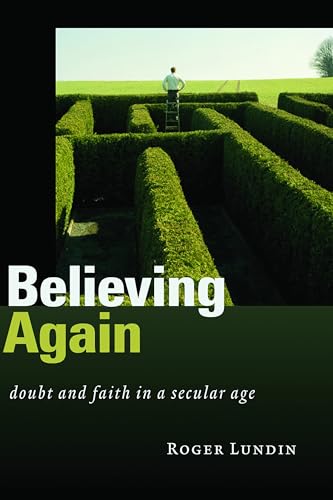
With a title like Believing Again, one could be forgiven for thinking that Roger Lundin’s recent volume is yet another response to the recent torrents of the New Atheists. But this is an altogether different project. The hint is in its title, Believing Again, which evokes the sentiments of W. H. Auden, “Every Christian has to make the transition from the child’s ‘We believe still’ to the adult’s ‘I believe again’ ” (Auden, Forewards and Afterwords[ed. Edward Mendelson; New York: Vintage, 1989], 518).
This side of the nineteenth century, the roaring clamor of suspicion has emptied the heavens, silencing both storm and whisper of their divine voice. Many studies have appeared over the years proposing various secularization hypotheses—most notably the recent work of Charles Taylor—and this volume is a useful compendium to the genre. (Cf. James Turner, Without God, Without Creed: The Origins of Unbelief in America[Baltimore: Johns Hopkins University Press, 1985]; George M. Marsden, The Soul of the American University: From Protestant Establishment to Established Nonbelief [New York: Oxford University Press, 1994]; Charles Taylor, A Secular Age [Cambridge: Belknap Press of Harvard University Press, 2007].) More than a mere condemnation of the phenomenon of secularization or a nostalgic peering over the shoulder at a universe once animated by divinity, Lundin’s volume is a candid study in detection, a pilgrimage after the epiphenomena that allowed for the possibility of secular sensibilities, where decided unbelief is a societal and intellectual option. But Believing Again is more than this. It is a societal and individual narrative on the possibilities of “believing again” in the adulthood of our current cultural moment “and the larger cultural context of that personal trek” (p. 2).
The volume is also colored with an emotive and personal hue. As a fifteen-year old, Lundin’s brother died during a routine surgery. English classes offered whatever sustenance there was for his “famished spirit.” While reading certain poets and novelists, he “heard voices that spoke into the heart of the void [his] life had become, and in heeding their call, [he] took [his] first steps on a long journey to belief” (p. 2). Many of those “poets and novelists” return and animate the pages throughout the historical setting of the book’s concerns, the substance of its cultural analysis, and the subject of its “theological response” (p. 2).
Lundin is interested in narrating nineteenth-century contexts and contemporary consequences. Though broken up into seven sections (history, science, belief, interpretation, reading, beauty, and story) and concluding with a meditation on Memory, the essays in this volume largely center on the posture of faith in a climate of unbelief with the aid of such theologians as Hans Urs von Balthasar, Karl Barth, and Dietrich Bonhoeffer, who offer responses to the challenges that Dostoevsky, Dickinson, Melville, and Milosz have set in their art.
Lundin sequesters the nineteenth century as the culprit that provided favorable conditions for unbelief to settle and indeed become familiar (p. 5). The advances of scientific exploration in the universe lead to what George Steiner has called “the silencing of the cosmos.” With the explanatory powers of science reaching near exhaustive levels, society bowed in awe and terror before a regally silent universe, while faint echoes could be heard of a retreating god from public discourse. This is what Max Weber termed “the disenchantment of the universe,” the belief that in nature “there are no mysterious incalculable forces that come into play, but rather that one can, in principle, master all things by calculation” (quoted on p. 35). Existence now consists of “an isolated self housed within an indifferent universe” (p. 94).
The brilliance of Believing Again is in its refusal to stop short at the mere subtraction story or to offer trite answers. The way forward for the community of faith is not the route of tawdry apologetics (cf. the comments of Boenhoffer, p. 8), but in theological (re) narration. Lundin, following Auden, sees a chastening effect from these recent developments: “Science has liberated men from a misplaced humility before a false god.” For Auden, the singular advance of science in the modern world “has been to demythologize the Universe … [which] may be seen as a gift from a gracious God” (quoted on p. 92).
This is precisely where “nimble belief” is required—a phrase Lundin borrows from Emily Dickinson. The journey of faith is a constant process of believing and non-believing. Believing in the triune creator God amidst the luring charms of cultural deities. The erosion of belief in our so-called secular age may well be a sort of felix culpa. For in its wake lay the death of a thousand gods. And as Karl Barth has written, “we are not left alone in this frightful world. Into this alien land God has come to us” (quoted on p. 24). Amid the rubble and carnage of these fallen deities, the rising God stands forth. And it is in this rising that we are “graciously enabled to hear within the sound and beyond the fury of our lives a tale told by one who freely suffers in love and whose suffering love signifies everything” (p. 263).
Though some might take issue with the “neat” and paradigmatic historical narrative and others wonder over the absence of Scripture’s testimony in this account, Believing Again is criticism at its best. It is an elegant narration of doubt and faith in a secular age through the anguish of an assortment of witnesses and how their struggle imbued their art and how their struggle can help us in ours. Aristotle once wrote, in so many words, “Before arriving at the right answer, we must first ask the right question.” This is worth pondering this side of the New Atheists and the Pew Forum survey. Instead of rushing into the fray of the mounting unbelief in the West with answers, it is worth pausing and asking why the unbelief is mounting. It is also worth considering the stories of those who struggled with a waning belief. For a useful guide in both instances, I can’t think of a better resource than Believing Again.