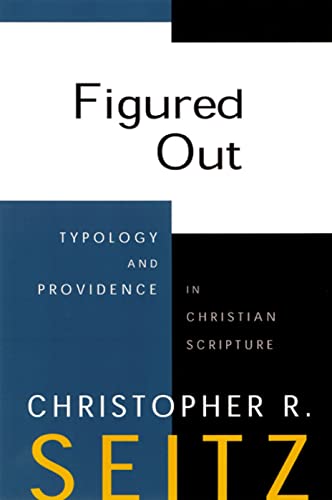

Professor Seitz’s most recent book is a tour de force that seeks to move beyond ‘historicism’ towards a theological and Christian reading of Scripture. Historicism is characterised as the belief that (1) ‘the presentation of Scripture must be recast through attention to origins and a theory of development’; (2) that this development implies corrections to (or sometimes deterioration from) the earlier strata of the tradition—in either case the idea that the old has given way to the new and (3) that ‘there is no special character to the way the literature has matured … that would disqualify an interrogation into what is believed to be “the true state of things” ’. That is, the canon and canonical shaping are not allowed to have priority over the questions of the historical formation of the material (83). An ex-doctoral student of Brevard Childs, Seitz explicitly acknowledges Childs’ ‘ongoing impact on [his] thinking’ (xii). It is, therefore, not surprising that Seitz dissents from what has been the way things are done in the academy for a long time. This is not to say that he rejects the critical positions of scholarship (‘I am fully a product of historical-critical assumptions’ (viii), but he does want to move on to something that is more productive for the church. (Interestingly, the book is quietly addressed to Christians—Cornelius was not a typical Gentile ‘in the sense that you and I once were, before we became Christians’, 125.)
The chapters (four of which have appeared, or will appear in other contexts) are wide-ranging and show an astonishing range of reading. (There can’t be that many books that include references both to Frank M. Cross’s work on the geographical distribution of pre-Masoretic Hebrew text types and Gregory Dix’s The Shape of the Liturgy.) The first half of the book (13–88) focuses on non-biblical resources and the second (91–190) looks explicitly at biblical texts. There are a number of different types of writing here along with several topics—liturgy, human sexuality, the use of Scripture and Anglicanism—are recurrent. The variety of styles ranges from dense (Acts 15 cites ‘a LXX rendering of Amos 9:6–15, whose Hebrew rendering was likely known by the Jerusalem church’, p. 121,—is Seitz saying that the Hebrew text used in Jerusalem was closer to the LXX than to the MT?), to brilliant (‘Anglo-Catholicism has created a movement of followers [that] Pusey would not be able to recognise as ‘catholic’ in any sense but haberdashery and ritualism’, p. 56, his italics).
I enjoyed this book, but the wide range of material covered made it hard to follow the argument clearly.
Cambridge