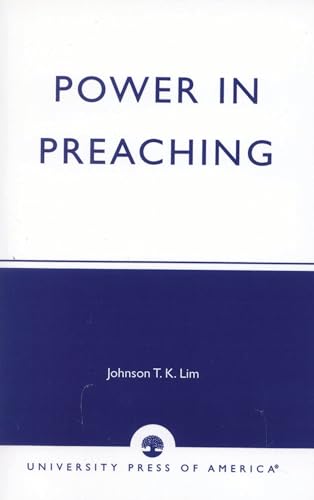

This book has been written by a preacher, for preachers, to address the contemporary problem in preaching. In the introduction to Power in Preaching, Johnson T.K. Lim identifies the problem as being twofold: a problem of communication and a spiritual problem. The net result of this is, as the title suggests, a lack of power in preaching—a lack of oratorical power (the communication problem) and a lack of the Spirit’s power (the spiritual problem).
Lim admits that ‘communication problems are easier to handle than spiritual problems’ (5) and certainly the bulk of his 172 pages deals with communication problems. Eleven of the thirteen chapters tackle such issues as ‘Who Are We?’ (as preachers); ‘What is Preaching All About?’ (‘Preaching is not merely instructional, inspirational but transformational’ (23); ‘A Preacher of the Text’ (exegesis); ‘What is a Sermon All About? (all his points begin with ‘S’!); ‘Preaching in a (Post)modern World’ (tell stories); and ‘Improving Oratorical Powers’ (‘cracking knuckles, armpit scratching, twitching … are bad habits that need to be eliminated’).
There are many helpful comments in these chapters and indeed addressing these communication problems takes up most of the book, but Lim’s much greater concern is with the spiritual problem in preaching, which he deals with in the chapter entitled ‘The Key to Power’. Although just one chapter this is really the heart of Lim’s concern—the fundamental problem with contemporary preaching is singular: a lack of the Spirit’s power and the solution to that problem also comes down to one thing: unction.
Without unction ultimately it does not matter how polished our sermons may be, or how persuasive are our oratorical abilities. Without divine unction we merely transmit information rather than transform lives.
According to Lim, unction is the key to power in preaching, as his re-writing of 1 Corinthians 13 demonstrates:
I may speak in the tongues of men or of angels, but if I have no unction I am only a sounding gong or a clanging cymbal … There are three important things in preaching: preparation, oratory and unction; but the greatest of these is unction.
There is nothing new in this chapter—merely a restating of Martyn Lloyd-Jones’s views from the Doctor himself or from Tony Sargent’s book on Lloyd-Jones: The Sacred Anointing. What unction is? (‘the smile of God upon the preacher’, 121); How to receive it? (‘We need to travail in prayer until God prevails’, 126); these are all key questions for Lim, for ‘Without unction our preaching will fail’ (131); ‘without unction [our preaching] kills instead of giving life’ (122).
Although at the end of his book Lim pleads for a balance between ‘human preparation’ and ‘divine dependence’, his own writing does not reflect it. Most of his book is taken up with ‘human preparation’, while the one chapter on ‘divine dependence’ puts all the weight on unction.
Undoubtedly Kim’s concern for powerful preaching is healthy and there is much here that could help, but ultimately that help is restrained by three detracting factors. First, there is no real argument here either in analysing the problems in preaching or in prescribing solutions. There is much assertion, some of it true, and all of it full of sincerity and conviction, but that’s not the same thing. Second, the style of writing is excessively rhetorical, which might (?) work in a pulpit but fails on the printed page. The editorial work is unfinished with words being left out of sentences fairly frequently and endless clichés being left in. ‘Much preaching also suffers from the paralysis of analysis … strong on diagnosis but weak in prognosis’. Third, all who preach and are concerned about preaching would agree that it is a spiritual endeavour and that therefore reliance on the work of God’s Spirit is of paramount importance, but whether there is any real help in reducing that truth down to a prescriptive and dogmatic notion of unction is very much open to question.
Lim grew up in the Chinese church in Malaysia; he ministers in that community and it is no doubt preachers in that same sphere of ministry who will find this book of most value.
Cornhill Training Course, London