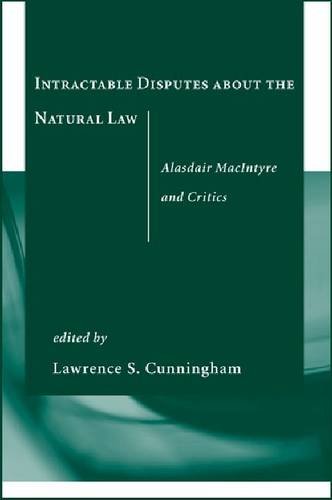
In 2004, Josef Ratzinger, then the prefect of the Congregation for the Defense of the Faith, asked the University of Notre Dame to undertake a symposium to address the problem of finding a common denominator for the moral principles held by all people. In response, the eminent moral philosopher and Notre Dame professor Alasdair MacIntyre produced the essay that comprises the first chapter of this volume. Eight other scholars, most of them also from Notre Dame, were asked to respond to MacIntyre or to develop his arguments. These responses comprise chapters 2–9. MacIntyre engages these essays in the final chapter. The result is an important and unique resource for anybody interested in the fundamental moral disputes of contemporary society, the role of natural law within these disputes, and the Christian’s task in negotiating them.
My comments will focus upon four essays, the two by MacIntyre and those by Jean Porter and Gerald McKenny. I do so because Porter and McKenny deal most specifically with the claims of MacIntyre’s original essay and because MacIntyre gives them the most attention in his concluding essay. These four chapters thus give the book its central thread.
MacIntyre’s opening essay analyzes moral disagreements and to what extent they can be resolved. The big problem is that Thomists, utilitarians, and Kantians all appeal to reason, yet they are unable to persuade many other rational people. MacIntyre focuses upon Thomism and utilitarianism and describes their views of rationality and the moral conclusions that each generates. He concludes that there is no set of neutral standards, equally available to both traditions, that can show one side to be true and the other false. MacIntyre therefore turns to each tradition’s historical record. If one makes better progress dealing with its own problems and also explaining the other’s problems, then it is rationally superior. He then outlines numerous problems afflicting utilitarianism and argues that it is only within the Thomistic Aristotelian tradition that its predicament can be understood. Yet the reluctance of utilitarians to agree with this conclusion is explainable: given their basic presuppositions, they are not open to arguments that would be fatal to their whole project. The precepts of the (Thomistic) natural law must therefore not be defended by trying to demonstrate the falsity of others’ conclusions but by attending to others’ premises and trying to undermine their belief in them through demonstrating their flaws and confusions.
Porter challenges MacIntyre’s conception that natural law precepts are universal at a specific level. She claims that the natural law, for Aquinas, is not tantamount to normative precepts that are both specific enough to be practiced and binding everywhere upon all. Thus, natural law itself does not resolve all moral disputes. Many contrary moral views may in fact be alternative and rationally legitimate ways of ordering behavior in accord with natural law. For Christians, specifying the general precepts of the natural law requires building to some degree on theological foundations. Moral disputes, therefore, should not be negotiated by trying to find a pre-existing moral code but by seeking to construct a set of mutually agreeable norms.
McKenny compares and contrasts the views of MacIntyre and Ratzinger on how Christian claims about moral reason can be maintained in the face of moral disagreement. McKenny thinks that MacIntyre makes a coherent case against moral relativism, but his views entail a certain relativism in practice. For MacIntyre, people have no rationally compelling grounds to accept his view of natural law as long as their own tradition has reasons for not giving up its premises. McKenny fears that MacIntyre’s view cannot avoid the moral standstills that have provoked calls for the allegedly neutral spectator to resolve disputes (along the lines of the liberalism that MacIntyre has long opposed).
MacIntyre’s closing essay engages each of the other authors, but especially Porter and McKenny. In response to Porter, he further defends his recognition of more universal and specific precepts of the natural law than she would allow. In response to McKenny, he critiques Ratzinger’s view that natural law claims are not fully credible or persuasive apart from their embodiment in a particular tradition or community and defends a stronger conception of the powers of reason.
This book is a success simply as a high-level scholarly discourse about important matters, in which the interlocutors deal with each other’s work seriously and respectfully and yet engage their disagreements openly. The volume will prove immensely useful for anyone wishing to understand the contemporary state of Roman Catholic debates about natural law and its significance for social life. Though this book does not represent all prominent Roman Catholic voices, it opens a window into a world of discussion.
The volume is useful and important not only for Roman Catholics seeking self-understanding but also for Protestants with any inkling of interest in natural law and Christian engagement in social life. Many Protestants have a caricatured view of what Roman Catholics believe about natural law, and a close read of this volume should help to dispel misconceptions and facilitate more accurate evaluation. The Roman Catholic authors in this book, contrary to stereotypes about Thomistic natural law as built upon autonomous human reason, debate the importance of the basic presuppositions underlying moral traditions, the effects of sin upon moral reasoning, the role of theological convictions in applying the natural law, and the significance of natural law being embodied in concrete historical communities. These are the very sorts of issues that have made many contemporary Protestants wary of the idea of natural law. MacIntyre concludes the volume with an invitation to other people, including “Reformed and Lutheran thinkers,” to join their conversation. Since many matters that are of concern to Protestants are already on the table, and since they have natural law traditions of their own waiting again to be tapped, I believe the invitation should be accepted. Reformation theology, in my judgment, provides a surer foundation for natural law than Roman Catholic thought, but Protestants have some catching up to do in current discussions.