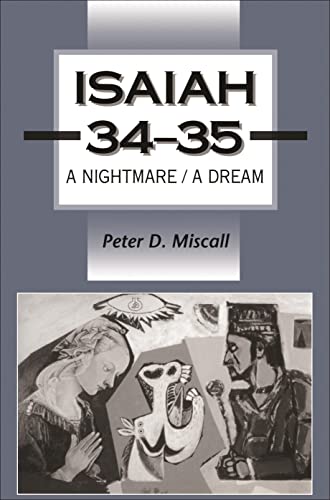
Miscall approaches Isaiah 34–35 as an example of the fantastic genre of literature. The vision of destruction in chapter 34 represents the nightmare, while that of restoration in chapter 35 (uneasily juxtaposed in what Miscall takes as the second section of a unified poem) represents the dream. Following a methodological explanation, the heart of the book comprises a translation and detailed examination of the text, based on close analysis of poetic and literary techniques. Although this is a short work, it is provocative in how it challenges both historical-critical and theologically predetermined approaches to the text.
In particular, Miscall resists the atomistic tendency to isolate chapters 34 and 35, thereby sidestepping the attendant critical agenda so concerned with questions of ‘authorship, date and relation to each other and the rest of Isaiah’ (9). In this, consonant with a core tenet of evangelical faith, he gives primacy to the text itself. However, he eschews the ‘religious and theological dichotomies of righteousness and sin and the salvation and judgement to which they lead’ (23) as likely to encourage a reading which substantially assumes ‘that we already know what the text is saying’ (39). In this, more problematically for the evangelical outlook, he insists that the text, should not be conformed to prior theological categories in a reductionist way. Instead, its possible meanings should be sought through attention to the poetic word in all of its rich nuance.
By following this reading strategy, in which Miscall stresses the polyvalent, allusive nature of the text, he demonstrates that scholarship which views these chapters ‘as an example of a general prophetic pattern of judgement on the nations and salvation for Israel’ (17) is too neatly schematic and fails to account for what is actually said. He argues that the horror inflicted in chapter 34 may not be confined to God’s supposed enemies, but may also include those who imagine themselves on the right side of God. Equally, he sees no reason to limit the vision of restoration and ingathering in chapter 35 to the ‘elect’.
Miscall is determined never to go beyond what the text permits and is opposed to theological interpretation. But in the context of a broader discussion of God’s justice he raises a disturbing theological issue concerning the nature of God. He observes that no reason is given for the divine violence in the poem and concludes, in terms consistent with his methodology, that even as the nightmare has hints of well-being, so the dream contains traces of violence. The two participate in each other and there are no grounds for completely separating them. If the heart of evangelical faith is affirming allegiance to God, Miscall relentlessly illustrates that, in the case of the God encoded in the Isaiah text, this ‘is not a simple affirmation’ (99), for this untamed God is no pussy-cat.
Miscall attempts to unsettle cosy assumptions, and he achieves his goal. Beyond whatever challenges he brings, however, his aim is not entirely negative, for he concludes by issuing an invitation for others to produce close readings of different sections of Isaiah. This is not anti-evangelical, but a stimulus to people of faith to revisit well-known passages of Scripture with new eyes and a minimum of doctrinal overlay for the word they might bring to new contexts of life.