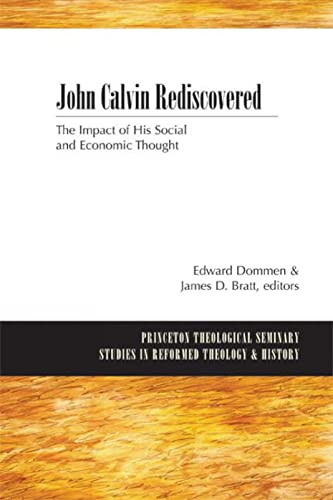
The year 2009 was redolent with various celebrations of the five hundredth birthday of Genevan Reformer John Calvin. Calvin, known for his Institutes of the Christian Religion and various biblical commentaries, is also known for the impact of his thought in areas beyond the strict limits of theology. In fact, Calvin’s name is often connected with the rise of republican democracy and capitalism. This book, John Calvin Rediscovered: The Impact of His Social and Economic Thought, preceded the five-hundredth birthday celebrations by two years and is the result of a conference sponsored by World Alliance of Reformed Churches, the University of Geneva Faculty of Theology, and the John Knox International Reformed Center held on November 3–6, 2004, to celebrate the publication of the English translation of André Biéler’s seminal work La Pensée économique et sociale de Calvin (Calvin’s Economic and Social Thought).
John Calvin Rediscovered is comprised of eleven chapters divided into three sections. Following the introduction by Edward Dommen, part one looks at “Calvin and His Age.” The highlight of part one for this reviewer was Robert Kingdon’s “Calvin and Church Discipline” (pp. 25–31). In this essay Kingdon delves into the role of the Genevan consistory. The consistory (what most Presbyterian churches refer to as the “session”) had oversight of marriage and sexual morality issues. Interestingly, the consistory also handled family and business disputes (p. 27). The consistory also looked out to eliminate residual Roman Catholic devotional practices. Another of its responsibilities was the discipline of those who showed disrespect for those in authority. As Kingdon points out, most Genevans (perhaps surprisingly) came to accept the role of the consistory in keeping the discipline of the community or removed themselves from the city (p. 28). Fascinatingly, while Calvin inculcated church discipline, he never included it in his marks of the true church. Later Calvinists would learn from Calvin’s practice and would maintain three marks of the true church: the pure preaching of the Word of God, the due administration of the sacraments, and the right use of discipline (pp. 30–31).
In part two on “Calvin’s Global Influence,” there were several interesting yet problematic chapters. In addition to gems like James Bratt’s “Abraham Kuyper’s Calvinism,” one finds Eduardo Golasso Faria’s “Calvin and Reformed Social Thought in Latin America” (pp. 93–108). Unfortunately, Faria begins by supporting the faulty Calvin-versus-the Calvinists historiography:
It is my intention to demonstrate how the American Presbyterian missionary vector in the nineteenth century, which was fundamental in shaping Latin American Protestantism, was rooted in deviations from Calvin’s thought which were current since the seventeenth-century Calvinism, but that it recovered in large part its “Calvinian” identity in the twentieth century. (p. 93)
This reader sought in vain for an argument to the effect that, for instance, Old Princeton had departed from Calvin’s thought. What one finds instead is the gratuitous assumption that it is so. Readers should be encouraged to turn to the work of Richard Muller others for an alternative assessment of the validity of the Calvin-versus-the Calvinists perspective. It is sad that Faria should start off on such a wrong foot. I would like to say he corrects himself. While the chapter is fascinating in revealing the history of the Liberal Protestant church in Latin America (and so it is not without value and interest on that score), there is no detailed discussion of what influence Calvin actually has had on the Latin American church beyond the claimed ressourcement of Calvin by missionary statesman Richard Shaull. Given Faria’s read on the Calvin-versus-the Calvinists historiography, this reader is not sanguine about the use of Calvin by Shaull. Throughout this essay there is a facile equation of the Christian message (i.e., the gospel) and social revolution, and somehow Calvin furthers into this equation.
The third section of the book, “Challenges in Translating John Calvin,” contains two very brief but intriguing chapters on translating Calvin into English and German. Peter Optiz’s “Translating Calvin into German” (pp. 143–49) illustrates that the hermeneutical obstacles to accurate translation are not limited to the Bible. Opitz discusses the intricacies of translating the words doctrina and religio. We are reminded that words are meaningful in actual usage and that this requires an awareness and familiarity with the cultural and historical context in which words are used. It was good to see that Opitz does not resort to skepticism about the possibility of translating one language into another. However, successful translation does require sensitivity to many linguistic and non-linguistic factors.
John Calvin Rediscovered is a mix of both good and poor essays. However, if you are looking for a book that unpacks Calvin’s teaching on social and economic ethics and then traces out his impact on the world since his own time, you will do better to start with a book like David Hall’s The Legacy of John Calvin: His Influence on the Modern World (Presbyterian & Reformed, 2008).