The debate over the so-called “new perspective on Paul” has divided up along fairly predictable lines. There are those who are attempting to preserve the emphases in a more “traditional” reading of Paul—that Paul was critiquing the anthropological optimism inherent in the soteriology of Early Judaism. On the “other side,” we can place those who are stressing that much of what Paul is critiquing is the ethnic exclusivism of his Jewish Christian contemporaries. Many on this side of the discussion have claimed that the structure of Paul’s soteriology is very similar to that of his Jewish heritage, however broadly conceived. When “traditional” readers of Paul hear this, it begins to sound as if there is little in Paul’s gospel that stands over against Judaism or the Law, leading them to wonder why Paul made such a fuss (as he appears to do in Galatians and Romans) and how the gospel of Christ is indeed far different from the Law. Many evangelical scholars who are sympathetic to “new perspective” impulses realize that questioning the traditional Protestant reading of Paul leaves them open to the charge of de-emphasizing justification by faith and placing slightly more stress on the other side of that tension in Pauline theology—that of a future judgment according to works. “New perspective” advocates have worked hard to maintain a proper balance here, though there is certainly more work to be done to articulate this properly.
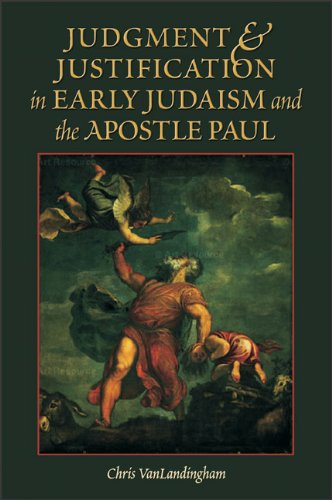
With this setting in mind, Chris VanLandingham advances the very bold thesis, in direct opposition to E. P. Sanders, that in Early Judaism the criterion for a favorable verdict at the final judgment is obedience to God’s commands. Whereas Sanders claimed that God’s election of Israel was foundational and prior to Israel’s keeping the Law, VanLandingham discerns an emphasis on Abraham’s obedience throughout the Jewish literature that has been sorely neglected by Jewish scholars. He then turns to Paul’s letters to note that the structure of Paul’s thought is much the same. The criterion for ultimate salvation of the individual before God is that of one’s deeds. VanLandingham seeks to separate himself from the majority of Pauline scholars at this point, too, in arguing that this obedience is not necessarily one that is empowered by God. God’s empowering grace does not come into view, so that those who claim that, in a sense, God’s future judgment has reference to the deeds God has produced in believers, is simply false.
In the end, VanLandingham will likely not find many who are in enthusiastic agreement with him. He has staked out some unique ground, some might say “extreme.” But he will have certainly provided some fresh fodder for a discussion that has bogged down, to some extent, over the last five or ten years.