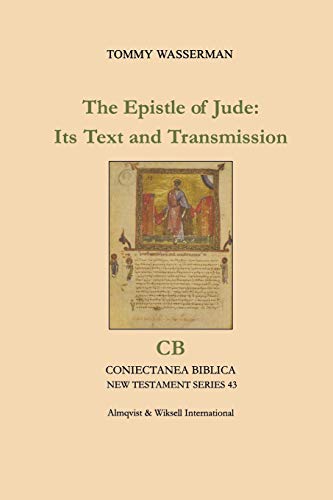
It cannot be said of many doctoral theses that they have made a major and permanent contribution to human knowledge, but it can be said of this one. What has been achieved in the course of this published version of a doctoral dissertation at Lund University is quite incredible. The author has examined and collated the text of Jude in 560 different manuscripts, that is, in virtually all the continuous-text manuscripts of the epistle. Thus a work has been done that has considerably advanced our knowledge of the text of the New Testament and will not need to be repeated. Such full collations previously had existed only for the Apocalypse.
Moreover, Jude is acknowledged to be one of the most textually complex books of the New Testament. Wasserman presents in condensed form the results of his collation, together with a critical edition of the text of Jude and a full textual commentary.
The work is divided into three basic sections: Prolegomena, Editio, and Commentarius, each being a little over one hundred pages. The Prolegomena consider the history of scholarship, look closely at two very early witnesses (P72 and P78), and examine the relationship between 2 Peter and Jude, concluding that Jude is prior. In the course of the monograph, Wasserman reviews the work of many scholars. One of the striking features of the discussions is how many major names seem to have fallen into demonstrable elementary technical errors (readers will have to consult the book itself to compile their own list). The author has also identified three new NT manuscripts and found that what were registered as two separate New Testament manuscripts were in fact merely one.
A significant conclusion relating to the text of Jude is that it has a unique history of textual transmission. This suggests that it was not initially transmitted alongside other books and makes problematic any view that it was first transmitted as part of a Catholic Epistles collection. I am fascinated by the following statement on page 123: ‘Interestingly, the genealogical data of the CBGM [Coherence Based Genealogical Method] for the two Petrine epistles suggest that their mutual textual history is more similar than that of the other Catholic Epistles, which suggests that 1–2 Peter were brought together earlier in the history of transmission.’ This passing statement, with no further reference, should be developed in full as it could have interesting implications for the reception of 2 Peter. The dissertation ends with sixteen plates of manuscripts.