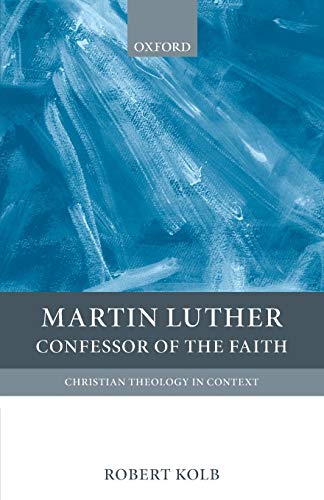
Oxford’s “Christian Theology in Context” is a series on a tightrope, attempting to tread that thin line between adequate treatment of both the theological contributions of major Christian thinkers and the historical contexts in which their thought developed. Attending to either of these concerns is a task unto itself, but balancing them, as Robert Kolb has managed to do in his recent installation in this series, is quite difficult, especially in two hundred pages or less. Yet because Kolb’s treatment of Luther seeks to place Luther’s theology in context, the book is primarily oriented theologically, rather than biographically.
In the first five chapters, Kolb focuses on the development of Luther as a reformer and theologian, giving special attention to influences that shaped his world of thought. Luther, he argues, does not fit neatly or consistently into any single school of thought common to the sixteenth century, but appears rather to have drawn eclectically from several existing traditions. German mystics enriched Luther’s understanding of faith as dependence upon God; the scholasticism of William of Ockham provided a foundation for thinking about God’s sovereignty, and Augustine for human inability and the need for grace. Yet as a Doctor of Exegesis, no influence quite approximated the importance that Scripture itself played in the development of Luther’s theology. Kolb considers the development of the “Wittenberg way” of reading Scripture, a “way” founded on the creative power of God’s Word, focused on God’s promise present in the Word, and implemented in a reform program that centered on the preaching and catechesis of the Word.
Each of the final five chapters is concerned with the dogmatic dimensions of Luther’s theology. In chapter six, Kolb briefly treats Luther’s anthropology, focusing on his Augustinian roots, his frustrations with Aristotelian metaphysics, and his tension between the sovereignty of God and the existence of evil. Kolb only briefly treats the much-discussed Finnish interpretation of Luther’s doctrine of union with Christ, drawing on Luther’s wedding imagery as support for a unity within differentiation (pp. 127–29). In the following chapter, Kolb traverses a wide amount of research, considering various interpretations of Luther’s Christology, especially his language surrounding the atonement. Luther has often been appropriated as belonging to this or that theory of the atonement, but Kolb rightly points out, “The atonement occasioned no controversies in the sixteenth century, and, therefore, elicited less than exact work on its formulation.” Consequently, “reading Luther in context reveals that he highlighted precisely those images of Christ’s work that spoke most directly to the pastoral problem specific sermons, treatises, or lectures were addressing” (118).
Kolb treats Luther’s theology of the oral and sacramental forms of the Word of God in chapter 8, “One Little Word Can Slay Him.” This chapter is a bit thin on the oral and scriptural form of God’s Word, but Kolb sufficiently weaves these themes throughout his treatment, clearing ground to treat the sacraments more thoroughly. The Eucharistic debates of the sixteenth century turned up a massive body of complex and sophisticated contemplation on the relationship between God’s presence and his Word. Though the author would certainly have wished to treat this topic more thoroughly, Kolb nicely distills the relevant points of debate within these twenty pages. The last two chapters consider the life of the Church in the world (its nature, purpose in history, and its spiritual warfare) and the Christian life (Luther’s ethic of love at work in familial, economic, and political contexts).
The whole value of a book like this is in the balance it strikes between length and depth. Surveying a field of study to which many scholars commit their lives is tricky business. The author is passing rapid judgment on massive tracts of interpretation within a page, a paragraph, or perhaps even a sentence! Yet this is precisely what makes Robert Kolb’s work here so salutary: in two hundred pages he manages to produce a sound, even-handed survey of the critical points of Luther’s theology in a minimally reductive manner, making the book ideal for those seeking introductory acquaintance with Luther’s theology. Brevity is lost on many modern authors; this book reminds us of its virtue.