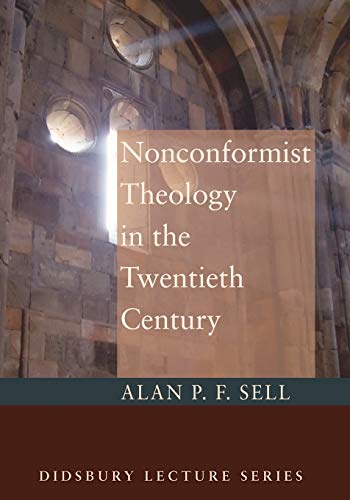
This work is based on Sell’s 2006 Didsbury Lectures, delivered at the Nazarene. College, Manchester. The author aims to provide the first comprehensive study of the systematic, doctrinal, and constructive theology produced within the major Nonconformist traditions in the United Kingdom during the twentieth century. His range includes Congregational, Baptist, Presbyterian, Unitarian, Methodist, and United Reformed theologians working primarily in these fields, but omitting others whose primary works are in biblical, moral, pastoral, and liturgical studies.
In his opening lecture, “Surveying the Landscape,” the author begins by highlighting the dramatic changes in opinions held in theological colleges in the late-nineteenth and early twentieth centuries. The strict confessional Calvinism in which many of these theologians or their predecessors had been brought up in Presbyterian, Baptist, or Congregational circles became a distant memory. A focus on the Fatherhood of God replaced old dogmas emphasising God’s sovereignty. The rise of a more liberal understanding of biblical truth led to a dearth of scholars interested in producing works of systematic theology (p. 11). The major concerns of the twentieth century began with the challenge of R. J. Campbell’s The New Theology, followed by the impact of the First World War on a society that was convinced of the upward evolutionary progress of humankind and by the anthropocentric liberal theology that accompanied it. The influence of Karl Barth was particularly powerful in arresting the influence of this humanistic dogma. Sell also draws attention to the work of the process theologians and the “Death of God” exponents in the 1960s, together with the Christological challenge of John Hick and others from the 1970s onwards, which brought about significant discussions on the credibility of exclusive truth claims for any one religion in a world of religious pluralism.
The second lecture, “Doctrinal Peaks,” covers contributions on the doctrines of the person and work of Christ, the Holy Spirit, and the Trinity. Sell argues that significant attention was given to the atonement earlier in the century, but in the last couple of decades the Trinity has rightly been the subject of even more studies. Many of the contributors rejected the historic penal substitution model of the atonement as unworthy of God. They also held very different views of sin and the efficacy of the death of Jesus. P. T. Forsyth, by contrast, was the major figure challenging these subjective interpretations of this doctrine. At a time when a majority of theologians were particularly elevating the incarnation of Jesus, Forsyth stood firmly as the theologian of the cross (p. 47). Colin Gunton and Baptist Paul Fiddes were the major contributors to this doctrine in the latter part of the century. Sell gives much less space to contributions on the person of Christ and the Trinity, and a particular weakness is his treatment of the Holy Spirit. All the works he cites come from scholars in the older Free Churches, but no contributions come from classic Pentecostals or writers from the more recent independent charismatic Churches; and, especially significant, no works cited are from the second half of the century.
The third lecture, “Ecclesiological Thickets,” addresses ecclesiology. Sell pays particular attention to the Genevan school (in Congregational ranks) that emphasised that the church meeting is a theocracy not a democracy (p. 102). His judicious selection of sources on the theology of baptism represents a range of primarily Baptist writers. He devotes much greater space to ecumenical relations between the churches. This is clearly a particular interest of the author, and the scholars whose work he discusses are usually ardently committed to the modern ecumenical movement. Sell is clearly a master of the vast literature on ecumenism, but students new to this field may struggle with the large amount of information he provides.
The fourth and final lecture is entitled “Rivers, Rivulets—and Encroaching Desert?” His focus here is mainly with eschatology. A major part of the presentation hints at books and authors that space precludes him from including. His final section laments the declining numbers of Nonconformists publishing significant works in systematic, doctrinal, or constructive theology from a base in a Nonconformist theological college, and the virtual absence of earned Doctor of Divinity degrees amongst its ministers, together with less rigorous training courses for ministry in theological colleges at the end of the twentieth century. This reviewer, while recognising the trends Sell identifies, suggests that the future of theological studies is not as bleak as he implies. Overall, while recognising the value of this work, the contributions of conservative evangelical scholars are notably absent—a choice Sell consciously makes (p. 2). He completely omits, for example, the Reformed theological revival in the second half of the twentieth century. Likewise, the discussion of the person and work of the Holy Spirit without a mention of Pentecostal or Charismatic contributions appears rather inadequate. The importance of this book will be as a valuable reference to the theological output of scholars in the older Free Churches in the last century.