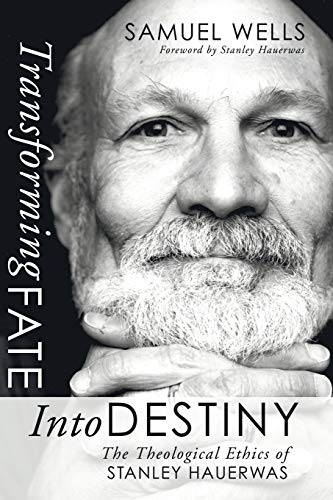
As the bibliography at the end of this work demonstrates, Stanley Hauerwas has become an extremely important figure in contemporary theological and ethical reflection. Although knowledge of his work is still growing in some sections of the world, the issues on his agenda are of world-wide concern. His writing appeals to many parties within the church, and contributes important reflection on how the church should relate to the world. All this means that Wells’ introduction and evaluation of Hauerwas is both timely and significant.
The various chapters in this work place Hauerwas within contemporary ethical debate, narrative theology, community, and ecclesiology. Along the way Wells provides a clear exposition of Hauerwas’s position, and offers avenues of criticism and exploration. For example, Wells offers the category of biography in order to help Hauerwas explore the ethics of character. In particular, towards the end he illustrates how eschatology might allow Hauerwas to escape some of the frequent criticisms made of his work (for example, Milbank’s criticism of founding virtue on antiquity, and Albrecht’s arguments concerning community).
Perhaps the most pressing criticism of Hauerwas for evangelicals concerns the nature of truth, and, as with the post-liberals, how to assess whether the Christian story is true, why we should choose these texts rather than many others. Wells attempts to address these problems for Hauerwas by introducing eschatology to hermeneutics, and although this may go somewhere to preserving an anchor (the telos) for epistemology, the problem of lying somewhere between foundationalism and a relativist narrative which leads to pluralism (both of which Hauerwas wishes to avoid) remains.
However, Wells has provided an excellent book. Not only does it survey Hauerwas and his work (and in the introduction Hauerwas himself writes that Wells ‘understand[s] me better than I understand myself’), but also serves well as an overview of some of the most important issues facing theology at the turn of the millennium. For a student already involved in theology there could be few other as good introductions to Hauerwas, narrative ethics, narrative theology, and the fundamental issues at stake in the conversations started by post-liberalism.