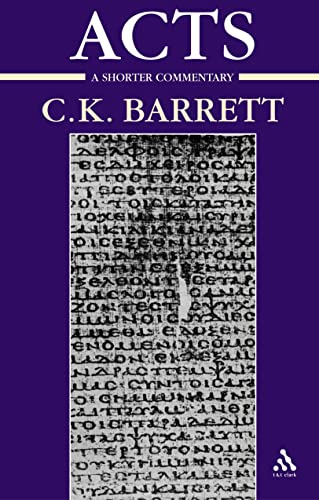
Following the example of C.E.B. Cranfield, who edited a shortened version of his two exhaustive ICC volumes on Paul’s Epistle to the Romans (Romans: A Shorter Commentary; T. & T. Clark/Eerdmans, 1985), C.K. Barrett has also provided at the publisher’s request a shortened version of his two similarly exhaustive ICC volumes on the Acts of the Apostles (A Critical and Exegetical Commentary on the Acts of the Apostles I: Preliminary Introduction and Commentary on Acts I–XIV and A Critical and Exegetical Commentary on the Acts of the Apostles II: Introduction and Commentary on Acts XV–XXVIII (Edinburgh: T. & T. Clark, 1994, 1998, 1272 pp.). The two volumes have been shortened throughout to about one third of the original size. All quotations in other languages have been removed. Barrett states in the preface:
This, with other economies, will mean that sometimes … conclusions are presented without the arguments, or at least without a full statement of the arguments, that may be supposed to justify them. This will inevitably … give the book a dogmatic flavour, which I should prefer to avoid (vii).
Barrett sets out with a detailed introduction, covering the textual tradition, the book and its author (discussion of the early attestation and of issues of authorship), sources and the plan of Acts, Acts as a historical source (‘Oddly it is on Christian matters that Luke is most open to criticism. His account of Hebrews and Hellenists, of Paul and the Council, is distorted by the refracting medium of continuing church life through which he views the past’, xl), a brief survey of the use and interpretation of Acts (xlii–l), a concise 25 page summary of the theology of Acts and Conclusions (including a discussion of the major discrepancies that Barrett finds between the Paul of Acts and the Paul of the epistles). In the following analysis Acts is treated in seventeen sections.
Barrett assesses Acts and its emphasis as follows:
Luke had grasped the fact that the only legitimacy that the Christian movement could claim was its origin in the life, teaching, death, and resurrection of Jesus of Nazareth, understood as the fulfilment of the OT. The continuity of between Jesus and the church was both historical and theological. Luke found it natural to concentrate on the historical side of this double strand, though from time to time he shows awareness of the theological. In both respects, moral-historical and theological, he would recall the church of his own day to the example of the earliest time (xxv).
Having worked intensively with Barrett’s two ICC volumes, I feel that their strength consists precisely in their detailed textual, grammatical and historical discussions, not necessarily in providing the larger picture of the purpose and theology of Acts. The picture and assessment provided by Barrett is not that fresh (e.g. in comparison with that of J. Jervell) but in many ways reminiscent of the dated and in several ways problematic F.C. Baur—Tübingen School approach to Acts (xliiif, lxxxv; cf. the critical discussion in B. Witherington, The Acts of the Apostles: A Socio-Rhetorical Commentary; Eerdmans / Paternoster, 1998, 243–47 and W.W. Gasque, A History of the Criticism of the Acts of the Apostles; Hendrickson, 1989, 21–106). Thus a shortened version without the material that made the larger editions particularly valuable, is not all that useful. Though rather lengthy Witherington’s volume would be a good alternative choice.