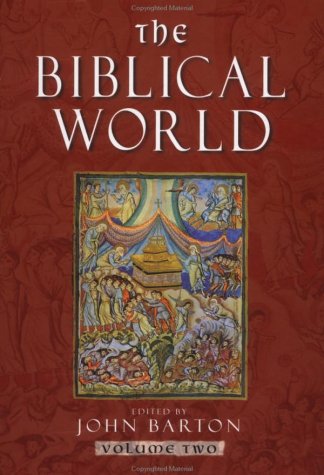

There is no doubt that John Barton as editor and Routledge as publisher have put together a very fine set which gathers forty-nine essays by forty-six eminent scholars in two very handsome and well-produced volumes.
The essays are grouped into eight parts. ‘The Bible’ includes three general essays on ‘The Old Testament/Hebrew Bible’, ‘The Apocrypha’ and ‘The New Testament’; ‘Genres’ includes eight essays on the main literary genres found within the Bible. ‘Documents’ is the heading for eight essays on biblical manuscripts, Hebrew inscriptions, etc; ‘History’ includes five essays on the main period of Israel’s history, plus one essay on archaeology and one on Israel’s neighbours; ‘Institutions’ includes ten essays on language, art, law, religion and more. ‘Biblical Figures’ highlights selected key figures from the biblical narratives in five chapters; ‘Religious Ideas’ includes five essays on notable aspects of Jewish and Christian theology; and finally ‘The Bible Today’ is the heading for three essays on translation and modern interpretation. Numerous black and white maps, illustrations and photographs enrich these volumes.
The way in which the authors of the essays present their material varies substantially. Some engage with the primary texts in the body of their essays and supply a bibliography (sometimes brief, sometimes lengthy) at the end. Others make brief reference to scholarship within the body of their essays while still others provide extensive endnotes which engage in detail with specific points in the secondary literature. Some essays are self-consciously written for those who are new to the subject in question, while others would, I think, prove very heavy going to anyone without previous theological training.
In general, the contributors and the views they express are representative of the mainstream of biblical scholarship. The Study of the history of Israel tends to represent the more sceptical (‘minimalist’) perspective. There are very few evangelical contributors, although some contributors at least demonstrate awareness of evangelical contributions.
Who is this set for? It is hard to say. Many beginners will find the pitch of the work rather high, the scale of the work rather daunting and the price of the work rather hefty. Scholars will probably regret the minimal specific engagement with scholarship in some of the essays. Perhaps it will be of most use to teachers who have some familiarity with the subject matter but who are looking for a concise, up-to-date survey from a mainstream perspective to set for students.
Alistair I. Wilson
Highland Theological College UHI
Dingwall, Scotland, UK