The famous missiologist and NT scholar Stephen Neill proposed that every aspiring theological student should study closely J. B. Lightfoot’s treatment of the apostolic fathers. This would instill, Neill thought, habits of exegesis and historical reasoning that would serve students well for a lifetime of interaction with biblical writings.
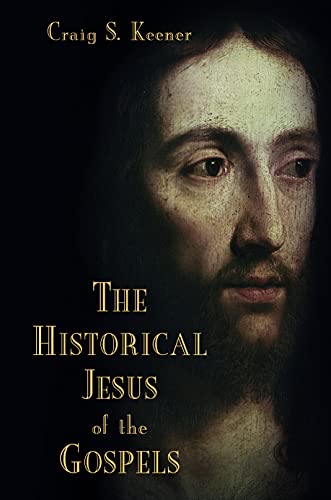
Something similar could be said of Craig Keener’s The Historical Jesus of the Gospels. Keener models an exemplary approach to the canonical Gospels, the background material both Jewish and otherwise, and the voluminous scholarship touching on these literatures. He has rendered a valuable service for any trying to make sense of Jesus studies in its multifarious and often bewildering contemporary forms.
The book appears so massive that one could despair of reading it. Never fear: the book proper ends at p. 393. Swelling the volume to its fuller imposing stature are detailed endnotes (over 200 pp.), bibliography (109 pp.), and indices (117 pp.). In addition, there are 43 pages of appendices on topics like Burton Mack’s theory of a Wisdom Q, Jewish biographical conventions, Roman capital punishment in Judea, and Jesus’ empty tomb.
The book proper is divided into three sections. “Disparate Views about Jesus” (pp. 1–69) sifts the history of Jesus scholarship. Here, as throughout the book, Keener reduces vast quantities of data into bite-sized presentations. For example, he describes the rise of Morton Smith’s “Secret Gospel of Mark” and outlines its exposure as the fraudulent document it is now known to be (p. 60). This entire section is a valuable accounting and assessment of major scholars, periods, and topics in Life of Jesus studies beginning roughly with Reimarus (1694–1768).
Section two, “The Character of the Gospels” (pp. 71–161), airs the most critical issues surrounding Gospel genre and features. Are our Gospels biography, and if so, in what sense and to what extent? Are they history, and what did “history” mean to writers of the NT era? What about “rhetoric” and the Gospels? And what about the source question, written and oral? Keener treats each of these questions in a full and methodical way. The extensive endnotes and bibliography enable the reader to dig deeper, whether into contemporary discussion or into key ancient sources.
Section three is by far the longest and deals with “What We Can Learn about Jesus from the Best Sources” (pp. 163–349). Significantly, for Keener that is a declaration and not a question. Those “best sources,” it turns out, are the four Gospels themselves. A significant contribution of this book is to have shown how backgrounds data and scholarly theories can inform Gospels-interpretation without overwhelming and replacing what the Gospels themselves say. Keener concludes that the Gospels are first-century documents, dependent on eyewitnesses. “There is much we can know about Jesus historically, and … the first-century Gospels preserved by the church remain by far the best source of this information” (p. 349).
One major subject missing from the book is that of miracles per se (cf. p. xxxii). Keener apologizes for this but avers it would have made the book unbearably long. He is doubtless correct. Nor does he claim comprehensiveness on the topics he does treat (in contrast to, say, Raymond Brown or John P. Meier in some of their respective treatments of Gospel- or Jesus-matters). Keener’s aim is rather sufficiently thorough treatment of subjects like (in section three) “Jesus the Teacher,” “Jesus’ Jewish Ethics,” “Jesus as Messiah?” and “The Resurrection.”
A helpful feature of the book is Keener’s allusions to his former atheism (e.g., pp. xxxv, 383–88). This material lends the spice of human interest to the entire volume. It also reminds the reader of the historiographical and hermeneutical fact that no reading of the Gospel is without its authorial baggage. By clarifying his own, Keener helps the reader gauge the possible distance between Keener’s observations about the subject matter, on the one hand, and what the subject matter actually signifies, on the other. With so many competing portraits of Jesus on offer in recent decades, many of the scholars active in the debate must be somewhat off the mark in their representations. Readers will have to decide for themselves whether Keener has brought fresh light or yet more obscurity to the discussion.
From my point of view, he succeeds at showing why his former atheism lacked intellectual rigor and persuasive force and why his settled, more mature, “high” view of Gospel-veracity has a great deal to commend it. More broadly, Keener has furnished one of the fuller, not to say saner, digests of Jesus studies to appear in the last couple of decades. Students, professors, and intellectually engaged pastors will turn to this book frequently and with great profit.