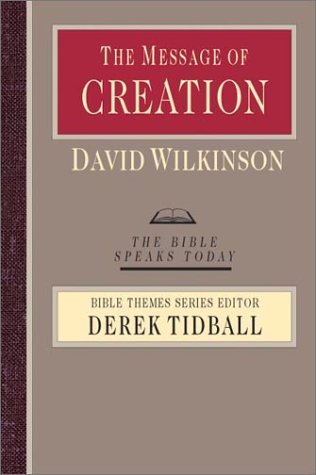
The key passages of Scripture relating to the theme of Creation are expounded and their progressive message drawn out in this excellent contribution to the new Bible Speaks Today Bible Themes Series.
The author is well suited to the task of this theme, being a research astrophysicist as well as a pastor and apologist-theologian. The reader therefore benefits from the combination of his close and stimulating reading of the Biblical text, his awareness of science, particularly but not exclusively astrophysics, and his pastor’s eye for contemporary illustration and pastoral application.
The book is divided into five parts, each of which contains four chapters dealing with different parts of Scripture.
The Beginning of Creation (Gen. 1–3) The Songs of Creation (Prov. 8:22–36, Pss. 8, 19, 148) The Lord of Creation (Luke 8:22–25, John 1:1–18, Col. 1:15–20, Heb. 1:1–14) The Lessons of Creation (Gen. 9:1–17, Job 38:1–42:17, Is. 40:9–31, Acts 17:16–34) The Fulfilment of Creation (Is. 65:17–25, Rom. 8:18–30, 2 Pet. 3:3–16, Rev. 21:1–18)
The beauty as well as the challenge of the Bible Themes format lies in the selection of texts. This author has served his readers well through judiciously chosen sections, well linked with reference to other Scriptures as appropriate. The texts are handled with great care (an impressive range of secondary scholarship has been consulted) but the author never loses the wood in the trees. The exegesis constantly reaches out into systematic theology, contemporary issues and pastoral applications. The diverse strands of the theme are tied together, not so tightly as to create an artificial interpretative straightjacket but so that they are allowed to sing together in a properly biblical harmony.
A warm tone suffuses the text, while personal anecdotes add colour without intruding too much authorial presence. The illustrative material is so apt and accurate that it seems churlish to point out that on page 257 we learn that ‘In 1900 the philosopher Jeremy Bentham proclaimed that once we have universal education all our problems will be solved’ (on the basis that ‘he being dead yet speaketh’ presumably?). I was also a bit surprised at way David Jenkins, former Bishop of Durham is cited on pages 188–89. But these are the exceptions that prove the rule since the text is studded with appropriate illustrations and suggestive application.
In his analysis of Genesis 1–3, in many ways potentially the most controversial section, the author says that although the date and means of creation are important the most significant question is not the ‘when?’ or even the ‘why?’ of creation but ‘who?’ For those wanting to pursue the question of ‘when?’, a useful appendix sets out five different positions held by evangelicals on the origin of the universe. Though the author is not a young earth creationist he shows notable respect for that position, as well as outlining the other main alternatives including the literary approach—which he favours.
His approach to this particular hot potato, both in the main text and the appendix, is such that Christians of widely differing positions should be able to read and recommend this book with confidence. That is very important since this is a book that will be of considerable help to small groups, Christian leaders and other believers wanting a serious and comprehensive study of a most important Biblical theme.