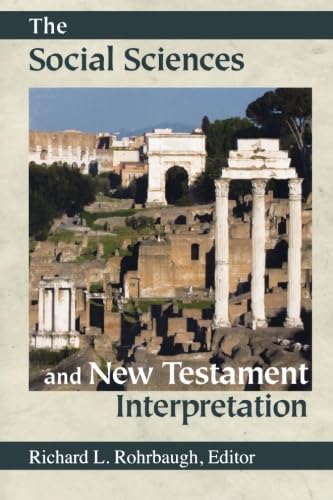
Social-scientific criticism of the Bible, including the New Testament, continues to be practised. However, I have not been struck by either its theoretical sophistication or the impressiveness of its results to date. The discussion tends to revolve around a small number of issues, such as honour and shame, and the virtually unbridgeable chasm between the first century and our own. This volume is, in many ways, indicative of the apparent struggle that social-scientific criticism of the New Testament is having in coming into its own as a discipline. By outlining the issues in several important areas, with reference to useful bibliography for further reading, this volume attempts to be an introduction to the field, but since it does not progress much beyond basics, it is doubtful that it will succeed. This collection draws together ten chapters by nine contributors (one has two essays), divided into three parts. Richard Rohrbaugh, the editor, writes a useful introduction to the volume, although I think that it makes the mistake of relying upon too many generalisations and stereotypes. For example, the alien character of the Bible or the fact that it was not written for westerners is stressed, and questionable analogies are drawn with contemporary Mediterranean culture, such as regarding the evil eye.
In the first part, on core values, Halvor Moxnes writes on honour and shame. An interesting feature of this treatment is his discussion of gender-related issues, providing a balance to the dichotomous thinking that sometimes attends this issue. Bruce Malina writes on New Testament persons. While he labels Wheeler Robinson’s concept of ‘corporate personality’ outdated, Malina ends up with a definition of the person that is heavily embedded in an anti-introspective, non-psychologically reflective collectivism. In his essay on kinship, K.C. Hanson argues for the integrated and intertwined nature of kinship relations as the focus of economic control in ancient Palestine. In a chapter on purity, Jerome Neyrey surveys past and present work on such terminology as clean and unclean, and holy and profane.
The second part of the volume is on social institutions, with Rohrbaugh discussing the pre-industrialised city. He usefully reminds us that the ancient city was not necessarily like the modern one. The dilemma is that most social-scientific research, by necessity, has not been concerned with the ancient city, and we are obligated to draw on a limited body of evidence and use sources that are not informed by modern urban theory. Douglas Oakman writes on the ancient economy, introducing the thought of Karl Polanyi. John Elliott writes on patronage and clientage, noting the abundant evidence from the ancient world for this important social institution, yet also realising that its application to NT has not yet been entirely successful.
The third and final part is on social dynamics. Neyrey writes on the importance of meals, food and table fellowship, introducing some useful material on who was included and why in table fellowship. Dennis Duling writes what I think is one of the two most potentially interesting of the chapters, on millennialism. One of its advantages is that it is less a survey of the secondary literature than many of the other chapters and more a taxonomy of the subject-area, drawing useful correlations between traditional work on millennarianism and social-scientifically informed studies. A limitation, however, is its brevity. In the final chapter, Lucretia Yaghjian writes on ancient reading. This too is a fascinating topic, and worth pursuing further for its implications, but here the essay gets bogged down in too much etymologising and what seems to me to be unnecessary labelling.
The most useful feature of this book is its historical dimension, in that it provides brief summaries of past research, along with bibliography. Nevertheless, these summaries are presented from a particular perspective, and one never seems to get much further in the discussion.