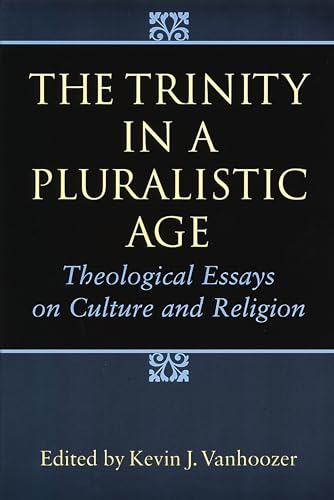
Must the empirical fact of the presence of many different religions (plurality) lead to the acceptance of pluralism as a worldview (the belief that the triune God has other names)? With the growing heterogeneity of populations and cultures, this question is becoming increasingly urgent. At the Fifth Edinburgh Dogmatics Conferences, August 31 to September 3, 1993 a group of scholars addressed this question, and this volume is a collection of their papers presented at that conference.
The contributors deal with a wider variety of intertwined issues. Lesslie Newbigin argues that Christian doctrine, with its prime model in the doctrine of the trinity, should play an explicitly, vigorous part in the debate that is taking place in the public square. It has something to say to the prevailing tendencies toward individualism and the exercise of power. Gerald Bray discusses the way the apologists related their views to those of pagan philosophy around them Stephen Williams considers the phenomenological similarity and differences of Trinitarian Christianity and other world religions. Kevin Vanhoozer argues that one can engage in dialogue with those of other religious persuasions, without assuming that all are talking about the same subject matter, by inviting others into the narrative that relates God in his trinitarian relations. Roland Poupin considers the question of whether there is a genuine trinitarian experience within Sufism. Colin Gunton relates the question of whether there is pluralism to the broader issues of how we gain knowledge, exploring the relationship of general revelation, natural theology, and a theology of nature, to the question of the Trinity, and Henri Blocher examines the issues of transcendence, immanence, and the Trinity. The final three chapters by Trevor Hart, Gary Badcock, and Richard Bauckham, deal with the relevance of the respective views of Karl Barth, Karl Rahner, and Jürgen Moltmann to the topic of the Trinity and religious pluralism.
As is typical of symposia, the chapters differ in their quality and relevance to the topic. Each of the authors demonstrates wide knowledge of the pertinent literature and the significant issues related to the subject. Theological students will probably find the most helpful chapters, with respect to general theological topics, to be those of Newbigin, Williams, Gunton, and Blocher. A more explicit indication of the logical relationships among the several chapters, and the way in which these are progressively expected to contribute to the overall subject, would be desirable. As it is, the chapters seem somewhat scattered in their focus. Some authors rather explicitly contradict each other (e.g., Vanhoozer and Gunton on Narrative). And, in light of Vanhoozer’s work on speech-act theory, the reader would expect a more explicit relating of that discipline to the topics at hand.
Factual and typographical errors are few and only one (notes 42 and 44 on page 55) is egregious. For the most part, the essays reflect an evangelical and biblical theology rejecting pluralism, but in an irenic fashion. In most cases, they presuppose a considerable familiarity with major world religions and with the debates about their interrelationships, at a level not usually possessed by students in the early stages of theological study. This is an important contribution to literature on religious pluralism, but not as an introduction.