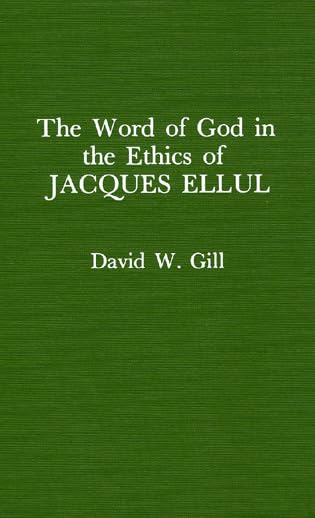
Jacques Ellul, for thirty-six years Professor in the Faculty of Law and Economic Sciences at Bordeaux University, holds a very high place among twentieth-century lay theologians. The prolific and provocative nature of his writings has attracted attention outside his own context of French Protestantism for some time but hitherto evaded the sustained and systematic analysis to which David Gill, an American Anabaptist, here subjects it.
Ellul acknowledges a debt to Barth, and this is readily visible in his description of morality per se as ‘a product of sin or disobedience’, his rejection of any ethics based on a doctrine of creation, his universalism and the radically Christocentric character of his ethics. Ellul’s influence by Kierkegaard is evident in his individualism which is not balanced by any adequate concept of the corporate possibilities of church life. Ellul’s distinctive contribution to modern Christian thought lies in his perceptive, powerful challenge to some of the major forces which shape our lives in the modern world. He has led a major assault on technique, a word which means the spirit of technology but something more, ‘the totality of methods, rationally arrived at and having absolute efficiency … in every field of human activity’. This has triumphed at the expense of moral judgment, true democracy, spontaneity, spiritual awareness, gratuitous areas of life, passion and human personality. Cities and city life are subjected to an equally searching critique. Ellul argues (half convincingly) that the city in the Bible is the spiritual symbol of humans acting in independence and rebellion against God. The growth of the nation-state with its perpetration of a whole series of political illusions is another characteristically modern ‘power of darkness’ in Ellul’s view.
Gill is sympathetic to and supports Ellul in many areas of his thought but is certainly not uncritical of him. He is probably right to fault Ellul for over-generalized statements and failure to suggest many positive alternatives to the ills which he diagnoses. His evaluations of Ellul’s achievement, however, are apt to assume a rather banal seven-out-of-ten flavour. Thus when commenting on Ellul’s bringing Christ into the centre of his ethical thought he says rather inanely: ‘For making this beginning Ellul is to be credited. For not following through more completely, and for distorting some passages slightly, he must be faulted’ (pp. 173–174). In the final pages, however, Gill appears to take some of these criticisms back by arguing that Ellul is better viewed as a prophet than an ethicist. But this begs so many questions that Gill would have been well advised to introduce the prophetic theme earlier and argue it at length.