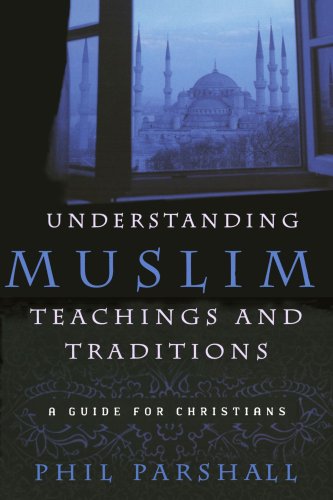
This book (referred to below as UMTT) is a re-issue of Parshall’s 1994 work Inside the Community: Understanding Muslims through their Traditions. Since many details of Muslim beliefs and practices are drawn from the words and deeds of Muhammad as recorded in the Hadith, or traditions, Parshall, a longstanding missionary, offers here a discussion of a selection of the more than 7,000 traditions gathered by al-Bukhari (810–70), a collection regarded by Sunni Muslims as the most authoritative. Each of the twenty-one chapters of UMTT treats a single topic, including the Qur’an, salvation, Muhammad, prayer, jihad and violence, hell, Jesus, women and Muhammad’s wives.
Parshall’s aim of raising Christians’ awareness of these traditions is worthwhile but his implementation is less satisfactory. On the positive side, careful referencing (explained on p. 11), enables the reader to find an individual tradition for themselves. (The translation used in UMTT, by Muhammad Muhsin Khan, can be viewed at, for example, www.usc.edu/dept/MSA/fundamentals/hadithsunnah/bukhari). Furthermore, Parshall’s clear categorization of topics by chapter enhances readability, and he is not afraid occasionally to include traditions that he considers reflect positively on Islam, such as Muhammad’s commendation of a simple lifestyle (220).
Yet rather than an attempt to understand Islamic traditions, UMTT is largely a handbook for using the Hadith as a springboard for explaining Christian faith to a Muslim. As a goal, this has its place, but it leads Parshall to move rapidly past actually entering into the world of the Hadith en route to frequently criticising them. The accuracy (occasionally) and the tone (very frequently), of Parshall’s comments give cause for concern, Jihad is glossed as ‘holy war’ (97) when its actual meaning, ‘struggle’, an elastic concept clearly encompassing holy war, extends further than this to include all exertion in God’s cause, including the struggle against sin. Muslims give as alms (zakat) 2.5% of their resources, not their income (91).
Questions of tone, however, are a more pressing concern. Discussing a reference to the wife’s mourning period of four months and ten days, Parshall comments: ‘But what was the mourning time for a husband whose wife had died? I tend to speculate it would be no longer than three days. So goes the male attitude that permeates Islam’ (223). Yet the mourning period is in fact the ‘idda, the time needed to determine whether the woman is pregnant. Hence, from an Islamic viewpoint there is a reason for such a time-period, a reason requiring explanation for the reader if understanding the traditions really is to be achieved.
Parshall periodically employs a dryly ironic tone that does not encourage the respect for the individual Muslim which can be held alongside differences over matters of belief. One Hadith states that God has created a cure for every disease. Parshall remarking, ‘I’m sure medical researchers would appreciate being informed of these cures’ (203).
UMTT abounds with generalisations, including some that set Islam against ‘the West’. For example, Islamic punishments are compared with practice in ‘Western prisons’ (122). Yet such statements are a reminder of the need to go beyond the Western/Islamic dichotomy in the light of the existence of Christians in many Muslim-majority states, increasing Muslim communities in ‘the West’ and the often non-Christian character of aspects of ‘Western’ culture.
Attention to both accuracy and tone are vital in moving forward Christian discussions of Islam, not in order to underplay serious differences of concerns, but for two rather different reasons. One is precisely to ensure that such discussions are taken seriously by Muslims themselves. Secondly, such attention is part of the call to ‘do to others what you would have them do to you’. So while UMTT has certain uses, I would recommend reading al-Bukhari for oneself.