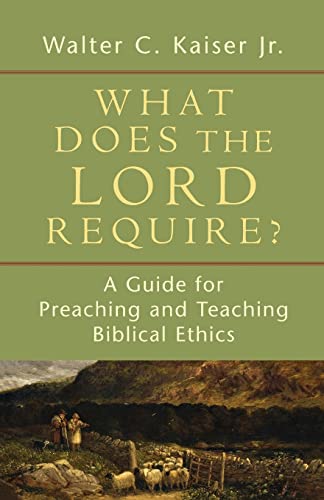

With this book, respected and prolific OT scholar Walter Kaiser offers a gift to the church by providing clear, accessible, and biblically-based discussions of a wide range of contemporary ethical issues. Kaiser has taught and written on biblical ethics for many years, so it is valuable to have an up-to-date and compact volume from him that seeks to facilitate discussion of ethics in the local church context. I hope that preachers and teachers in many seminaries and local churches will welcome and use the book.
The main distinctive of Kaiser’s book is his strategy of focusing on one or two main “teaching passages” from the Bible in dealing with each of the ethical issues he addresses. The eighteen chapters of the book each consist of an introduction to the ethical issue under discussion (e.g., gambling, divorce, abortion, genetic engineering, civil disobedience). In the introduction to each chapter, Kaiser offers statistics and social commentary in order to highlight and clarify the ethical issue. In some chapters, he also weaves into this discussion a range of Scripture passages. He then moves into a focused exposition of one or two main teaching passages that bear on the ethical issue treated in the chapter. The exposition includes an outline of the biblical passage followed by verse-by-verse discussion. For example, in the chapter on abortion and stem cell research, Kaiser exposits Ps 139:13–18 and Exod 21:22–25. In the chapter on suicide, infanticide, and euthanasia, he focuses on Job 14:1–6. Each chapter ends with a summary of the argument, suggested bibliography for further reading, and discussion questions.
The greatest strength of this book is its clear focus on the Bible as the source of Christian ethics. Kaiser demonstrates his skill as an interpreter of Scripture, drawing upon his many years of close study of the text and managing to write with clarity and simplicity. His strategy of focusing on one or two main teaching passages in each chapter usually works quite well and sets this book apart from other evangelical books on ethics. It allows Kaiser to engage more closely with some of the most important Scriptural resources for various ethical issues and to treat these passages in a contextual fashion, not simply “cherry-picking” isolated verses here and there. In this respect, the book offers not only solid content but also an important methodological model for preachers and teachers.
The book is not without some weaknesses. At times the research for the opening sections discussing the various ethical issues feels a bit derivative. Kaiser draws a great deal of his facts and analysis from other evangelical books on ethics (particularly Kerby Anderson’s Christian Ethics in Plain Language). In addition, the decision to focus on one or two main teaching passages, which is the main distinctive and contribution of the book, can at times be somewhat limiting. Because there are eighteen chapters and the book is quite short, the extensive focus on one or two main Scripture passages limits Kaiser’s ability to discuss ethical issues in depth. For this reason, the book will perhaps be better used in seminary classrooms as a supplement to, rather than a replacement of, other standard evangelical works on ethics. In several chapters, the chosen teaching passages do not shed as much light on the ethical issue being discussed as one might hope. For example, Kaiser chooses to exposit Matt 6:19–34 in the chapter on gambling and greed. While this passage does address the matter of greed, it does not offer direct insight on gambling, which is the focus of Kaiser’s discussion in the first part of the chapter. Similarly, while Gen 1:26–30 and 2:15–25 are surely important background for the discussion of genetic engineering and artificial reproduction, it would have been helpful for Kaiser to be more specific in demonstrating how these Genesis texts translate into a thoughtful, informed, critical opinion on the ethics of genetic engineering and artificial reproduction.
Despite these weaknesses, the book is the kind of solid, informed, clearly written work we expect from Kaiser. It will be particularly helpful for pastors and students as they seek to engage with the Bible in addressing the significant ethical issues of our day.
Stephen Witmer is the pastor of Pepperell Christian Fellowship in Pepperell, Massachusetts, is an editorial board member of Themelios, and teaches New Testament at Gordon-Conwell Theological Seminary.
I didn’t come from an Evangelical home, and though he never told me outright, I’m sure my father never wanted me to become a pastor. I can’t blame him—not one bit. My father was a corporate attorney who traveled in circles of power and influence.…
Reformed paedobaptists frequently cite Col 2:11–12 as evidence that baptism replaces circumcision as the covenant sign signifying the same realities. For example, question 74 in the Heidelberg Catechism asks...
New Testament scholarship in its present state is experiencing a time of abundance, especially with respect to biblical commentaries of every shape, length, level of depth, theological persuasion, intended audience, and hermeneutical angle. This is, indeed, of value to researchers and ministers who have a…
It might seem odd to write an editorial for a theological journal on the topic of not doing theology and how important that can be; and, indeed, perhaps it is contrarian even by my own exacting standards. But it is nonetheless important. Let me explain.
Most readers of Themelios will be aware that the word “perfectionism” is commonly attached in theological circles to one subset of the Wesleyan tradition. As far as I can tell, the numbers who defend such perfectionism today are rather depleted. They hold that progressive sanctification…