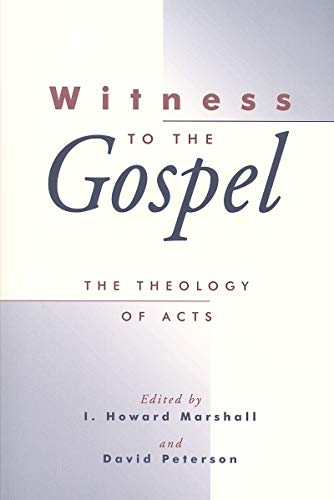
This volume ably achieves its goal of providing ‘a comprehensive survey of the theology of Acts’ and in doing so meets a long-standing need in Luke-Acts studies. Under the general editorship of I. Howard Marshall and David Peterson, the volume is the fruit of a well conceived project. Twenty-four contributors, nine of whom have an Aberdeen Ph.D., were selected to write in their particular area of expertise regarding Lukan theology. The editors then gathered a significant number of them to a 1995 symposium where working drafts of all the papers were discussed. The result is a unified volume of both a common methodological approach, articulated by Marshall (ch. 1), and a broadly shared understanding of the nature of Acts. Acts is ‘primarily about God’s action in offering salvation through Jesus Christ to both Jews and Gentiles and thereby creating a new people of God’ (16).
The volume expounds this understanding in three roughly equal parts. Part One, ‘The Salvation of God’, focuses on the nature of the divine provision of salvation. Very much in keeping with Marshall’s view that in Acts narrative is the vehicle of theology, this section begins with chapters on the plan of God (Squires), Scripture and the realisation of God’s promises (Bock), and the eschatology of Acts (Nolland). There follows an exposition of the meaning of salvation (Green) and a presentation of Acts’ christology of the divine saviour and servant (Buckwalter). The section concludes with an articulation of Acts’ anthropology, especially as it relates to the fall, showing the nature of the need for salvation (Stenschke) and another discussion of Acts’ soteriology (Witherington), this time against the background of first century understandings of salvation and health.
Part Two, ‘The Call of God’, deals in theological themes concerning the way the message of salvation was made known. The initial chapters consider the bearers of the message through the themes of ‘apostle’ (Clark) and ‘witness’ and ‘mission’ (Bolt). For Clark apostles are more ‘authorised delegates’ than missionaries. But for Bolt, the twelve and Paul are ‘the witnesses’, though it is God who is consistently ‘on mission’, The next two chapters deal with the character of the mission advance as ‘progress of the Word’ (Rosner), yet in the midst of opposition and persecution (Rapske). The section concludes with three chapters on the theology in the preaching of Acts: Peter’s (Bayer); Stephen’s (Neudorfer); and Paul’s (Hansen).
Part Three, ‘The Renewing Work of God’, considers the experience and character of the saved people. The section begins with mature and balanced expositions of Acts’ theology of the Holy Spirit (Turner) and the church (Seccombe). After a discussion of worship (Peterson), there is a thorough case for an understanding that Luke did not see the OT law as having a role in the Christian’s life (Blomberg). Following a treatment of Acts 18–20 as evidence for innovation in mission practice under the influence of universal mission theology (Towner), there is a section on the application of new methods to Acts. Canonical criticism tackles ‘Israel and the Gentile Mission’ with the aid of intertextuality techniques within Acts and comparisons with Romans 9–11 (Wall). The perils and promise of social scientific criticism are assessed (Barton). The section concludes with studies on early church life according to Acts, first with a mainly historical study on the influence of Jewish worship practices (Blue) and then with a clear description of the relation of the ‘community of goods’ to meal fellowship against the background of the communal ideal, friendship reciprocity, and patronage in ancient Graeco-Roman culture (Capper). Peterson concludes the volume by drawing the strands of Acts’ theology together to weave a case for a particular overall purpose: ‘a reassurance about the triumph of the Word through suffering’.
The volume is commendable for its overall organisation, format in presentation, and way it fulfils its intentions. It intends to provide ‘solid exegetical foundations’ for understanding the theology of Acts, to give some account of the state of current research on the various theological themes, and to provide creative interpretations of the topics. These aims, in the main, are achieved. Nolland responds to Conzelmann and gives a fresh presentation of a Lukan eschatology as genuinely imminent and involving continuity between stages of salvation history. Stenschke furthers the understanding of Lukan anthropology by showing a view of human corruption which effectively critiques Taeger’s assessment. Rapske presents a comprehensive, integrated handling of the opposition/suffering/persecution aspect of Acts’ theology in such a way that the common accusation of Luke’s triumphalism can properly be laid to rest. Neudorfer’s fresh handling of Stephen’s speech provides a profile of the theological emphases of the Jerusalem Hellenistic Jewish Christians, an area often neglected in Acts theology. Turner’s pneumatology of Acts soundly addresses all the interpretational issues related to the Spirit in Acts. It is probably the most valuable contribution to the volume. Seccombe gives a helpful treatment of Acts’ use of ekklesia as the basis for a cross-cultural understanding of the church. Blomberg, while not convincing this reviewer, certainly has marshalled all the evidence on the law in Acts and argued quite strongly for his view.
Other strengths are the consistent appropriation of first century background for illumining Acts’ distinctive presentation of theological themes, the capturing of Acts’ vibrancy around the motifs of ‘God on mission’ and the comprehensive, yet balanced, portrayal of the progress of the gospel in the midst of opposition.
There are a few weaknesses or ‘loose ends’, but these have a positive effect: creating an agenda for further study. Sometimes historical problems are glossed over (e.g., Neudorfer, 286). Green and Witherington differ on Acts’ understanding of salvation, especially the primacy of the spiritual dimension. Clark and Bolt differ on who are the messengers of the good news. The ‘new methods’ chapters do not fully serve theological exposition.
Witness to the Gospel is a valuable guide for the student of Acts’ theology and an indispensable resource for the scholar who desires to enter and forward the conversation.