
Introduction to Exodus
Discover the Basics of the Book of Exodus
Text and photos curated from The ESV Study Bible
In partnership with Crossway
Discover the Basics of the Book of Exodus
This introductory course is designed to provide key insights into the book of Exodus by pulling together a number of key resources: overview videos from The Bible Project, helpful contextual information from The ESV Study Bible, commentary recommendations from The Gospel Coalition, a single sermon that sums up the book from beginning to end by Mark Dever, and much more. By watching, listening to, and reading these resources, you’ll be better prepared to read, study, teach, or preach the book of Exodus.
Doubts have often been cast on the historical reliability of the exodus account. It is true that no remains of the Israelites have been found in the area of Goshen in the eastern Nile delta or in the wilderness of Sinai. But in neither area would such remains be expected to survive. The mud-built huts of the Israelites have long been destroyed by repeated flooding, and, wandering through the wilderness, the people would not have left buildings or other permanent traces. It thus is unreasonable to expect such archaeological evidence. Furthermore, one should not expect to find extrabiblical texts regarding Israel’s stay and departure from Egypt, because the story is negative about Egypt. Egyptian texts are quite propagandistic and would not mention such a defeat.
Nevertheless there is plenty of data that seems to corroborate the biblical account:
This archaeological evidence makes skepticism about the historicity of the biblical account of the exodus unwarranted. This is not to deny that the story is told to make theological points: much historical writing is motivated by the desire to teach lessons from the past. Nor does the archaeological evidence require one to believe that the book of Exodus gives a complete and full account of what happened: there are obviously many gaps and events that are passed over. But the evidence does make it unreasonable to challenge the central affirmation of OT faith: “I am the Lord your God, who brought you out of the land of Egypt, out of the house of slavery” (Ex. 20:2).
Taken from the ESV® Study Bible (The Holy Bible, English Standard Version®), copyright ©2008 by Crossway, a publishing ministry of Good News Publishers. Used by permission. All rights reserved.
Exodus is an adventure story par excellence. It features a cruel villain (Pharaoh), an unlikely hero (Moses), overwhelming disasters (the plagues), a spectacular deliverance (crossing the Red Sea), a long journey (through the wilderness), a mountaintop experience (where Moses received the Ten Commandments), and a grand finale (the presence of God coming down to the ark of the covenant, filling the tabernacle with glory). The story features unexpected setbacks and unpredictable delays, magic tricks (from Pharaoh’s sorcerers) and miracles, feasts and festivals, music and dancing, and many close encounters with the living God. God’s purpose in all of this was to show his glory by fulfilling the promises he made to his people in the covenant. The exodus is the archetypal deliverance of the OT—the definitive salvation event that established the identity of Israel as the people of God and demonstrated the character of their Deliverer as the God who saves.
The basic framework of the book is epic. Epics begin with a nation in crisis, and this epic opens with the Israelites languishing in slavery and their would-be deliverer born under the threat of death by drowning. The story proceeds along epic lines, with a cosmic confrontation between good and evil that is happily resolved through a mighty act of rescue and a long journey to freedom. Moses is the heroic (albeit imperfect) national leader who serves as the human instrument of a divine deliverance. Like many epics, Exodus is also the story of the founding of a nation. This helps to explain how the second half of the book connects to the first: once the people of God are delivered from bondage, they meet to receive a national constitution (the Ten Commandments) and to establish a place for their national assembly (the tabernacle). Within its epic framework, Exodus also contains a wealth of subgenres: rescue story, calling story, human-divine encounter, diplomatic negotiation, plague story, genealogy, institution of a festival, song of victory, travelogue, miracle story, legal code, case law, covenant renewal ceremony, architectural blueprint, garment design, building narrative.
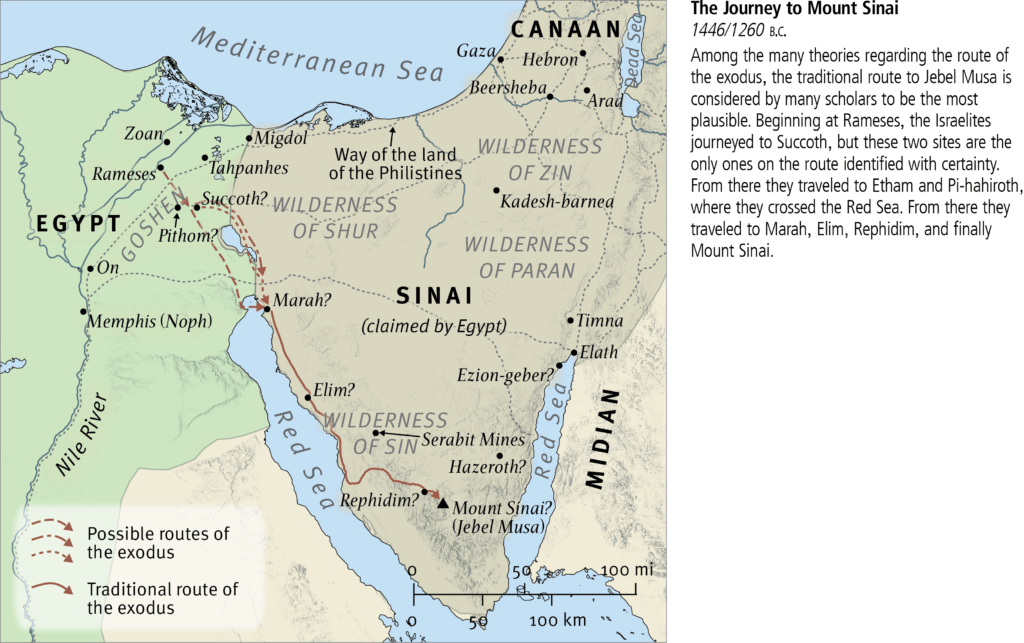
Taken from the ESV® Study Bible (The Holy Bible, English Standard Version®), copyright ©2008 by Crossway, a publishing ministry of Good News Publishers. Used by permission. All rights reserved.
The overarching theme of Exodus is the fulfillment of God’s promises to the patriarchs that he would make their descendants a great nation. This is carried out despite the opposition of the greatest superpower in the ancient world of the time, Egypt, and despite the unbelief and disobedience of the people themselves. Exodus shows that the success of the exodus must be ascribed first to the power and character of God, who remembers his promises, punishes sin, and forgives the penitent. Second, it highlights both the faithfulness of Moses, who follows divine instructions exactly, and his prayerfulness. It is his prayer, e.g., that leads to victory over Amalek (Ex. 17:8–16) and his intercession that persuades God to pardon the people after they had begun worshiping the golden calf (chs. 32–34).
The events and instructions narrated in the book of Exodus are explicitly framed as the Lord remembering his covenant promises to Abraham (Ex. 2:24; 3:6, 14–17; 6:2–8). The promises include land, numerous offspring, and blessing for both Abraham’s descendants and the nations (Gen. 12:1–3), which are rooted in the covenant relationship with the Lord: “I will establish my covenant between me and you and your offspring after you . . . and I will be their God” (Gen. 17:7–8). The covenant promises in Genesis were made with Abraham and reaffirmed with Isaac and Jacob. Exodus highlights the role that Moses fills as the covenant mediator through whom the Lord reveals his purposes to his people and sustains the covenant relationship. Each of these aspects will be described briefly in relation to key themes in Exodus.
Exodus is the second book in the Pentateuch and picks up the narrative of Genesis by focusing on the time when the sons of Jacob (Ex. 1:1–6) have grown into the people of Israel (Ex. 1:8). The first half of the book records events that fulfill the promise to Abraham that his descendants would sojourn in a land that was not their own, be afflicted for 400 years, and then come out by the Lord’s hand with numerous possessions (Gen. 15:13–14). The narrative of Israel’s preservation in and exodus out of Egypt is sometimes referred to as being like a second creation account both because the vocabulary seems to evoke the first chapters of Genesis (see Ex. 1:7) and because it is through Abraham’s descendants that the Lord has promised to bless all nations and thus to restore his presence and purposes in the world (Gen. 12:1–3).
The second half of the book narrates the events surrounding the covenant being revealed, confirmed, broken, and renewed (Exodus 19; 24; 32–34; 35–40) and records the covenant instructions that the Lord revealed to Israel through Moses at Mount Sinai (chs. 20–23; 25–31). The instructions begin with the Ten Commandments (20:1–21) and include a lengthy section detailing the specifics for the construction of the tabernacle and its service (Ex. 25:1–31:18). But this is not the totality of the Lord’s covenant instructions, which are recorded further in both Leviticus and Numbers before Israel finally leaves the region of Mount Sinai for the land of Canaan (Num. 10:11ff.).
Numbers describes how the generation who came out of Egypt ended up wandering in the wilderness instead of entering Canaan. Then the book of Deuteronomy records Moses’ reaffirmation of the covenant instructions recorded in Exodus through Numbers and appeals to the next generation who will enter the land to keep the commandments by fearing the Lord and walking in his ways (Deut. 8:6).
Within the story of man’s salvation, the book of Exodus describes a great forward step. The book of Genesis showed the plight of the human race and its need for salvation. The call of Abraham began the process of divine rescue. Then Jacob’s migration to Egypt seemed to put the plan aside. But in a most dramatic fashion Exodus shows the divine plan reactivated. Heaven-sent plagues force the Egyptians to let Israel go. Then, accompanied by the cloud of God’s presence, they travel toward the promised land of Canaan. Pausing en route at Mount Sinai, they hear God declare to them his laws and seal his covenant with them. Israel is already God’s people by virtue of the promises to Abraham; this covenant establishes the people as a theocracy, in which the covenant specifies the operations of the civil and social, as well as religious, aspects of Israel’s life. Despite their prompt disregard of their covenantal relationship in the worship of the golden calf, the covenant is renewed and the tabernacle is built, a pledge of God’s continuing presence with them. The book ends with the glory of God filling the tabernacle, ready to lead the people to the Promised Land.
The NT sees the OT exodus story as the pattern for the ministry and death of Christ. In him God “dwelt [lit., “tabernacled”] among us, and we have seen his glory” (John 1:14). Jesus sojourned in Egypt, and then came out, fulfilling the pattern of Israel (Matt. 2:15, using Hos. 11:1). At the Last Supper, a Passover meal (cf. Exodus 12–13), Jesus referred to “the new covenant in my blood” (Luke 22:20), echoing Moses’ words in Exodus 24:8. He also described his death as the exodus (ESV, “departure”; Gk. exodos) that he would accomplish at Jerusalem (Luke 9:31). As Jesus reenacted the exodus in his own life and death, so must his followers. Baptism into his death identifies the believer with the Israelites’ passage through the Red Sea, and partaking of his spiritual food and drink identifies the believer with their experiences in the wilderness (1 Cor. 10:1–3). Finally, in heaven, believers shall sing the Song of Moses and the Lamb (Rev. 15:3; cf. Exodus 15).
Taken from the ESV® Study Bible (The Holy Bible, English Standard Version®), copyright ©2008 by Crossway, a publishing ministry of Good News Publishers. Used by permission. All rights reserved.
Taken from the ESV® Study Bible (The Holy Bible, English Standard Version®), copyright ©2008 by Crossway, a publishing ministry of Good News Publishers. Used by permission. All rights reserved. For more information on how to cite this material, see permissions information here.
Difficulty: 2/5
Substantial exposition for conscientious readers.
Difficulty: 3/5
Substantial theological analysis and exposition for knowledgable readers.