



Introduction to Joel
Discover the Basics of the Book of Joel
Text and photos curated from The ESV Study Bible
In partnership with Crossway
Discover the Basics of the Book of Joel
This introductory course is designed to provide key insights into the book of Joel by pulling together a number of key resources: overview videos from The Bible Project, helpful contextual information from The ESV Study Bible, commentary recommendations from The Gospel Coalition, a single sermon that sums up the book from beginning to end by Mark Dever, and much more. By watching, listening to, and reading these resources, you’ll be better prepared to read, study, teach, or preach the book of Joel.
As a work of prophecy, the book of Joel relies on the staples of the oracle of judgment and the oracle of salvation. Poetry counts for a lot in the book of Joel, whose author is particularly adept at description. By the time Joel’s imagination amplifies the killer locusts into more-than-literal creatures, the book of Joel emerges as almost a horror story. The technique of apostrophe (direct address to entities that are literally absent but treated as though they can hear and respond) is prominent in the first two chapters. Even though the writer is a prophet rather than a nature writer, there are so many pictures of nature in the book that it does rank as nature writing, in a prophetic mode.
The most striking literary feature of the book is the way in which Joel’s imagination amplifies literal locusts into images of apocalyptic horror—pictures of God’s judgment against human sinfulness. Of course Joel’s images are a timeless and universal picture of punishment from God for human evil.
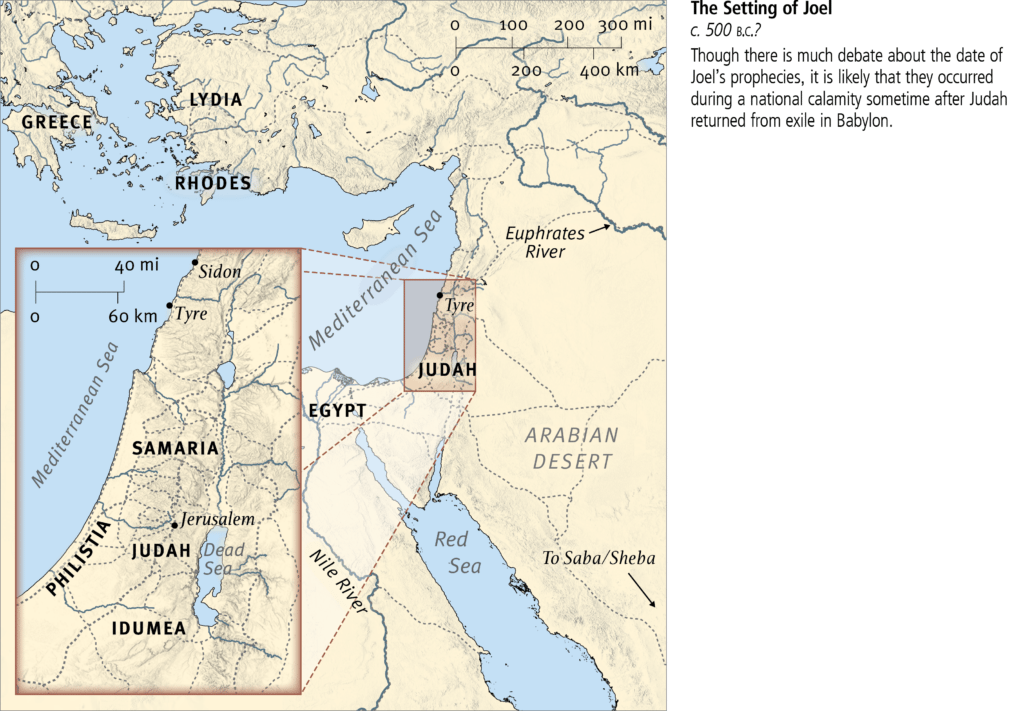
Taken from the ESV® Study Bible (The Holy Bible, English Standard Version®), copyright ©2008 by Crossway, a publishing ministry of Good News Publishers. Used by permission. All rights reserved. For more information on how to cite this material, see permissions information here.
The relationship between the locust plague and drought (Joel 1:1–20) and the onslaught of the Lord’s army (Joel 2:1–11) provides a major challenge to readers. Scholars provide a number of options, as outlined in the chart below. While there are serious arguments for each of those options, the third fits best with the overall context. Joel uses the imagery of a dramatic locust plague along with military imagery (Joel 2:4–9) to describe the coming of the Lord’s army on his great day (Joel 2:11). The verbs of chapter 1 are predominantly imperative and past-tense forms, calling the people to act based on past events. The verbs in chapter 2 are in the imperfect and imperative forms, highlighting the fact that, though the judgment is approaching, a return to God is still possible. The lament of Joel 1:15–20 is clearly concerned with the effects of the locusts, while the prayer of Joel 2:17 focuses not upon the destruction of locusts but rather upon the depressed social status of the people of God threatened by foreign rule. Reference to the “northerner” is a typical OT description of enemies (see ESV Study Bible note on Joel 2:20) but an unusual label if referring to a swarm of locusts. The judgment of the nations in Joel 3:1–21 makes better sense contextually if chapter 2 portrays the threat of an army and a decisive conflict. These and other reasons support option 3.
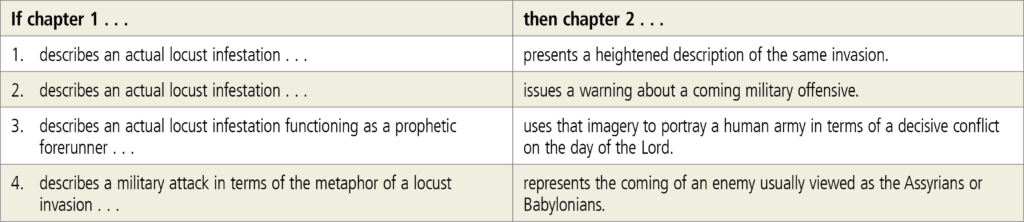
Taken from the ESV® Study Bible (The Holy Bible, English Standard Version®), copyright ©2008 by Crossway, a publishing ministry of Good News Publishers. Used by permission. All rights reserved. For more information on how to cite this material, see permissions information here.
The “day of the Lord” is the dominant theme of the book of Joel. Both the nations (Joel 3:2–3) and Israel (Joel 1:15; 2:1–2) experience this judgment. However, for the repentant community, the “day” also holds out the hope of restoration (Joel 2:12–14). Ultimately, the Lord’s covenant faithfulness is expressed in his promises of abundance and protection (2:23–26; 3:1), which evidence his dwelling in the midst of his people (Joel 2:27; 3:17, 21). This is epitomized in the great promise of “my Spirit” that would be poured out on “all flesh” (Joel 2:28, 29; cf. Acts 2:17–21).
1. Day of the Lord. This is the major theme of Joel. The exact expression, yom yhwh (Hb., “day of the Lord”), is found five times in Joel (Joel 1:15; 2:1, 11, 31; 3:14) and 13 times in seven other prophetic books (Isa. 13:6, 9; Jer. 46:10; Ezek. 13:5; 30:3; Amos 5:18–20; Obad. 15; Zeph. 1:7, 14; Mal. 4:5; see ESV Study Bible note on Amos 5:18–20). Other ways of referring to the “day” found throughout prophetic literature (e.g., “a day,” “those days,” “that day”) are used by Joel as well (Joel 2:2; 3:1, 18). Within Joel, the “day” refers not only to a final day of judgment upon the nations (Joel 3:2) but also to God’s ongoing judgment of Israel, both past and future (Joel 1:15; 2:2, 11), and instances of his intervention between Israel and the nations (Joel 3:1–2, 12, 14, 16). In each case, the “day of the Lord” indicates a time when the presence of the Lord brings judgment and/or deliverance and blessing, depending on the circumstances (see ESV Study Bible note on Joel 1:15). Therefore, although the “day” heralds destruction for the nations, it also functions as a time of salvation for God’s people; the Lord remains a refuge amid the chaos of judgment (Joel 3:15–16).
2. Repentance. If the whole community would cry out to the Lord (Joel 1:13–20) and look to him—not merely with external actions but in sincerity with their whole persons (Joel 2:12–13)—then judgment may be averted. However, the Lord is not bound by the acts of the community (Joel 2:14); it is his prerogative to send or withhold the destruction by the locusts (Joel 1:15), just as the army is his to command (Joel 2:11).
3. The Lord in their midst. It is, of course, crucial that the people have a living faith and repentance; however, the reason the Lord will turn from judgment to blessing is to express his covenant-keeping character (Joel 2:13, 18–26; 3:18). His promise to dwell in the midst of his people is prominent not only in Joel (Joel 2:27; 3:17, 21) but also throughout the OT (Num. 35:34; Deut. 6:15; 7:21; Isa. 12:6; Hos. 11:9; Zeph. 3:15, 17; Hag. 2:5; Zech. 2:10–11; 8:3). God’s restoration of what the locusts have destroyed (Joel 2:27) and his protection of Israel as the cosmos crumbles (Joel 3:16–17) both have the same goal: knowledge of his presence. This theme concludes the book (Joel 3:21), highlighting its importance for Joel.
4. These themes—the day of the Lord, repentance, and God dwelling amid his people—converge in the promise of the future outpouring of the Spirit (Joel 2:28–32). This outpouring is associated with the day of the Lord (Joel 2:31) in both its judgmental (Joel 2:30–31; cf. Joel 2:10; 3:15) and its saving (Joel 2:32) manifestations. It is related to repentance in that those who are saved are those who call “on the name of the Lord” (Joel 2:32). Finally, the giving of the Spirit, crossing all boundaries of gender, generation, social class, or nationality (Joel 2:28–29), is the ultimate evidence of God “in the midst of them” (Isa. 63:11; see Hag. 2:5).
Joel calls all the inhabitants of Judah and Jerusalem to lament and return to the Lord during a time of national calamity. This crisis is precipitated in the first instance by a locust plague that has destroyed both wine (Joel 1:5, 7, 12) and grain (Joel 1:10) and therefore threatens the ability of the people of God to present offerings in the temple (Joel 1:9, 13, 16). Given this background, Joel may have served as a lament in the ongoing life of God’s people during other times of national tragedy.
God called his ancient people in love and mercy, he preserved them to be the vehicle through which he poured out his Spirit on all kinds of people (Joel 2:28–32), and he will preserve them against all who seek to destroy them (ch. 3). In all of his care for them, he aims for “torn” hearts, and not just torn garments, from his people (Joel 2:12–14), that they might love him with their whole hearts.
Taken from the ESV® Study Bible (The Holy Bible, English Standard Version®), copyright ©2008 by Crossway, a publishing ministry of Good News Publishers. Used by permission. All rights reserved. For more information on how to cite this material, see permissions information here.
Taken from the ESV® Study Bible (The Holy Bible, English Standard Version®), copyright ©2008 by Crossway, a publishing ministry of Good News Publishers. Used by permission. All rights reserved. For more information on how to cite this material, see permissions information here.
Difficulty: 2/5
Substantial exposition for conscientious readers.
Difficulty: 3/5
Substantial theological analysis and exposition for knowledgable readers.