
×
Protected: Study Genesis
Curated by Jennifer Brogdon
In partnership with Jason DeRouchie

Introduction to the Course

About Jason DeRouchie

Jason is a churchman, scholar, husband, and father. He is committed to helping others exalt Jesus and treasure the hope of the gospel from the whole of Christian Scripture—the Old and New Testaments. He has six children, three adopted from Ethiopia. He is a former associate pastor and presently serves as an elder of Bethlehem Baptist Church. He has taught in a number of Christian colleges and seminaries and joyfully serves now as Professor of Old Testament and Biblical Theology at Bethlehem College & Seminary in Minneapolis. You can find more information about his ministry and more useful resources at jasonderouchie.com.


About the Course

DeRouchie claims Genesis as the most foundational worldview-shaping book of the Bible. Its author is anonymous but likely written by Moses to a people struggling with sin, who know death, as they walk in the wilderness for forty years. Genesis answers the questions: What is wrong with the world and what is the solution?


Advice for Reading Genesis
  1. Use Genesis 1:1–2:3 as a lens for understanding God’s purpose and humanity’s
    purpose in God’s world.
  2. Keep in mind the major plot: God’s intervention in the history of human
    fallenness by providing a means for a restored blessing.
  3. Keep in mind the several sub-plots:
    a. Adamic/Noahic Covenant (Gen. 1–2; ch. 9) + Abrahamic Covenant (12:2–
    7; 15:1–21; 17:3–8).
    b. God’s kingdom expands through a community of kingdom families (Gen.
    1:26–28; 2:4–25).
    c. The promise of a special “offspring/seed” who would conquer the enemies of
    God—War of Judgment/Holy War motif (Gen. 3:14–15; 12:7; 22:17; cf.
    Exod. 15:1–18; Gal. 3:16).
    d. Faith in the promise of God is foundational for a relationship with him (Gen.
    15:6; 22:12; cf. 12:1–3).
    e. God is always faithful to his promise despite the ups and downs of life

By Jason S. DeRouchie ©

2018 www.jasonderouchie.com.

The Blessing Commission (Gen. 1:1-2:3)

Genesis 1:1-2:3

In this lecture, DeRouchie breaks down what the text says about God, humanity, and the Earth.

  • Runtime: 50 min

The Israelite Context and Significance of Genesis 1
  1. Genesis 1 comes to us through a distinct form of special revelation. God may have disclosed this revelation very early, or he may have given it directly to Moses, perhaps on Mt.
    Sinai during the 6+1 days of tabernacle revelation (Exod 24:15; cf. the 6+1
    speeches in Exod 25–31).
  2. The audience were those recently confronted with their sin (be it at the golden calf episode [Exod 32–24] or the rebellion at Kadesh [Num 13–14]), who were being continually reminded of its results through 38 years of wilderness punishment. It is these people to whom Genesis 1 is first revealed as Bible.
  3. I propose that there must be more than chronology or science at stake here.
    Genesis 1:1–2:3 is designed for a people asking not, “How did God create everything?” but, “How can I live and not die?” To this group, the Bible’s opening chapter speaks a worldview-shaping message.

Gen. 1:1–2:3 as Introductory to Scripture

The historical narrative that dominates
Genesis–Kings begins in Gen. 2:4. This makes Gen. 1:1–2:3 introductory and raises the question of why it fronts Genesis, the Pentateuch, the OT, and Bible as a whole.

  1. Gen. 1:1–2:3 is clearly not a first-hand, eye-witness account; rather, the week was disclosed through special revelation that was well-established in Israel’s tradition (Exod. 16:22–30) even before God revealed the Ten Words at Mount Sinai (20:8–11).
  2. There seems to be an intentional parallel with the building instructions of the tabernacle in Exodus, for the 6+1 pattern, is seen in each. In Exodus, the tabernacle building instructions are given over six days, the last of which
    shows the equipping of two humans to oversee the project (Exod 25:1; 30:11, 17,
    22, 34; 31:1); the seventh day then discloses God’s purpose for Sabbath (31:12). These parallels do not by nature require that the former was crafted to image the latter, though the presence of this connection suggests that Israel would have seen God’s creating of the heavens and earth as the establishment of a cosmic temple.
  3. The makeup and experience of the original audience on Gen 1:1–2:3 as we presently have it would have been post-fall and, in its present form, post-golden calf and perhaps wilderness rebellion. This suggests the rhetorical purpose of Gen. 1:1–2:3 is more than to clarify origins or chronology (though not less). Life and death is at stake, and these verses become one of the most foundational worldview shaping texts in all the Bible, answering at least in part, all the major worldview questions: Who is God? What is valuable? Where are we? Who are we? What is wrong with the world? What is the solution? Gen. 1:1–2:3 tells the reader not only what happened but how things are supposed to be.

Different Interpretations of Gen 1:1–2:3 from the Perspective of History and Science
  1. 24 Hour Mature Earth View: God created all of physical creation out of nothing
    in six successive calendar days.
  2. Day-Age View: God created all of physical creation out of nothing in a
    chronological progression of ages spanning an indefinite period of time.
  3. Framework View: God created all of physical creation out of nothing, but
    Genesis 1:1–2:3 portrays this move of God through a literary, temporal
    framework and topical arrangement that may or may not have anything to do
    with actual chronology.
  4. Non-material, Functional View: In Genesis 1:1–2:3, God is not creating the
    material universe but is instead giving functions to already existing matter over
    six successive days (John Walton, The Lost World of Genesis One).
  5. Promised Land View: Genesis 1:1 speaks of God creating the universe out of
    nothing, but Genesis 1:2–2:4 testify to his preparation of the Promised
    Land/Garden of Eden for humanity (John Sailhamer, Genesis Unbound).

Stake out your position on creation’s origins, including the meaning of the days of creation in Genesis 1, the possibility of
evolution, the historicity of Adam and Eve, the age of the earth, and any other related issues. While Genesis addresses larger
issues of God’s purpose in creation and the realities of sin and redemption, what does it say and what does it require and not
require regarding our beliefs in origins?

Questions of Origins

After considering the origin of creation on your own, download and read this document.
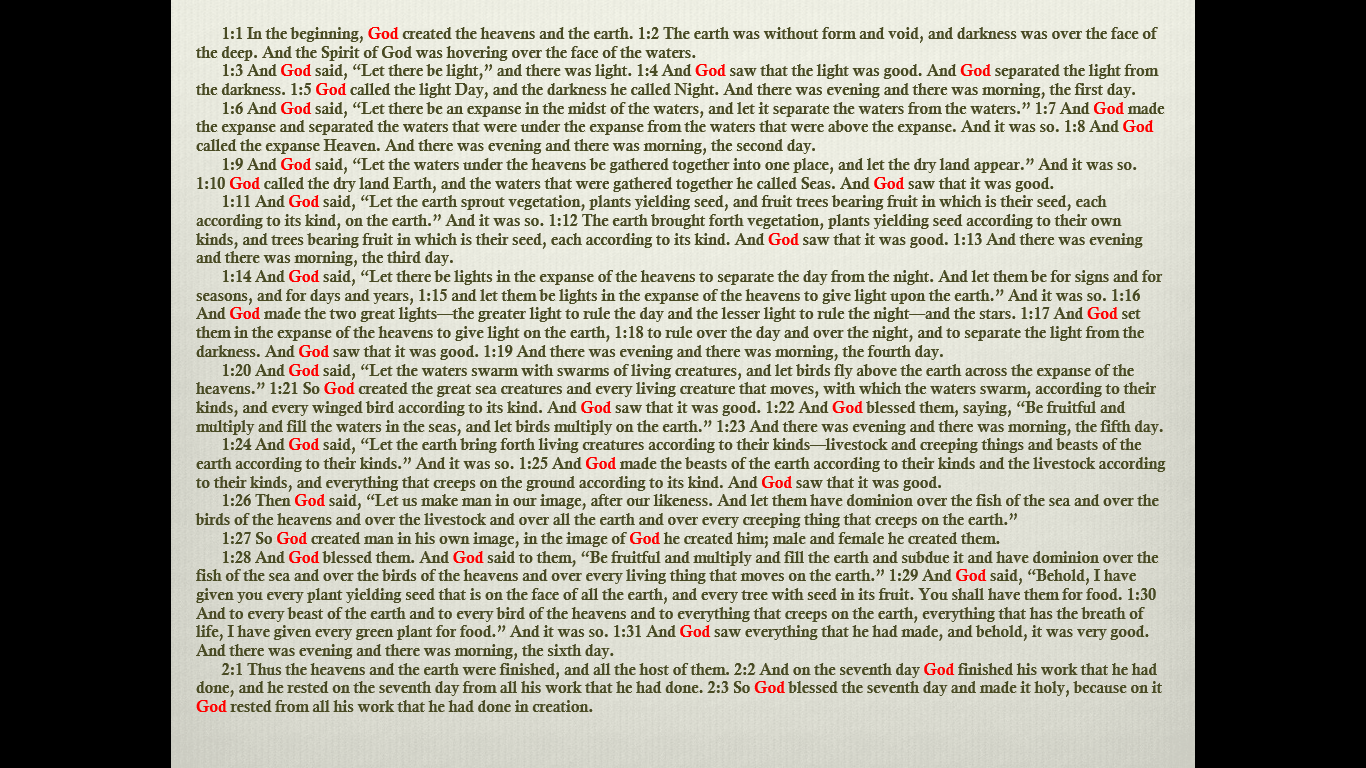

The Biblical View of Creation: God as the Source, Sustainer, and Goal of All Things
  • God is supreme.
    • Gen. 1:1 – In the beginning, God created the heavens and the earth.
    • Col. 1:16-17 – For by him all things were created, in heaven and on earth, visible and invisible, whether thrones or dominions or rulers or authorities—all things were created through him and for him.
    • Implications:
      • No polytheism, pantheism, or naturalism
    • Deut. 10:17 – [Yahweh is] the great, the mighty, and the awesome God.
  • God is the value-setter.
    • Gen. 1:4, 10, 12, 18, 21, 25, 31. And God saw that it was (very) good.
    • God determines what’s good and evil.
  • God is righteous.
    • Gen. 2:2-3 – And on the seventh day God finished his work that he had done, and he rested on the seventh day from all his work that he had done. So God blessed the seventh day and made it holy because on it God rested from all his work that he had done in creation.
    • God’s righteousness is his desire for his own glory.
  • God is self-exalting. – “God” 34 times in this passage:

Reflection Questions:
  1. Who or what governs reality?
  2. Who are you?
  3. Where are you?
  4. What is valuable in this world?
  5. What has gone wrong in this world?
  6. What is the remedy?
  7. According to what this passage says about God, how are you doing about thinking about God this way?
  8. Where do you see the dependency on God in this section?
  9. Where do you see God’s provision in the text?

Lecture Notes

This document provides further detailed lecture notes.


By Jason S. DeRouchie © 2018 www.jasonderouchie.com.

The Need for Blessing (Gen. 2:4-4:26)

Distinct Roles Given in the Creation Account (2:4–25)
  • God’s Role: Ruler – “And the Lord God” (cf. Matt. 19:6)
  • Man’s Role: Servant & Guardian (Gen. 2:15-20; cf. Eph. 5)
  • Woman’s Role: Helper (Gen. 2:18; cf. Ps. 121)

The Fall and the Curse (3:1–24)

Satan’s Scheme: Role Reversal (3:1–6; cf. 1 Tim. 2:12–14)

  • The Nature of Sin
    • Any motivation, action, or thought that fails to align with God’s definition of what is right and wrong, good and evil; failure to trust God’s timing and way.
    • Rom. 14:23. Whatever does not proceed from faith is sin.
    • 1 John 3:4. Everyone who makes a practice of sinning also practices lawlessness; sin is lawlessness.
    • Jas. 4:17. Whoever knows the right thing to do and fails to do it, for him it is sin.
  • Man’s Passivity & Aggression (3:6, 12)
  • The Curse (3:15–19)
    • Role Frustration and Global Frustration (3:16–19; cf. Rom. 8:20–21)

Gospel-Promise through Judgment (3:15-24)
  • 2 Family Trees opposing one another (Gen. 3:15)
  • A Male, Curse-Overcomer
  • Exile (3:22-24)


Grace Rejected & Grace Embraced (4:1–26)
  • Cain’s Hopeful Beginning & Downfall (4:1–24)
    • Celebration at God’s gift (4:1)
    • Unwillingness to Come to the Light (4:2–16)
    • The Offspring of the Serpent Defined (4:17–24)
  • Seth’s Hopeful Start (4:25–26)
    • The Offspring of the Woman Embraced (4:25–26)

Summary of Section
  • We have a mission of God-empowered servant leadership and helping.
  • Satan is real and deceptive and sin is destructive.
  • Passivity, aggression, and self-exaltation over others are all signs of sin and the curse.
  • There is hope for sinners who (1) look to the promised, male, curse-overcoming offspring of the woman and (2) call on the name of the Lord.
  • God’s final word is blessing, not curse; he will fulfill his good intention for the world.

By Jason S. DeRouchie ©

2018 www.jasonderouchie.com.

Filling the Earth (Gen. 5:1-6:8)

Gen. 5:1-6:8

In this lecture, DeRouchie expands on the genealogies and the 2 groups of descent present.

  • Runtime: 51 min

What are two reasons for the genealogies in this passage?

The Structure of the Passage

Whereas the last unit ended with an extended history of the “line of destruction” (4:1–24) and a small comment on the “line of promise” (4:25–26), this section focuses principally on the line of promise through an extended linear genealogy from Adam to Noah (5:1–32); brief comment is then made regarding the vast scope of the line of destruction and God’s wrath against the world (6:1– 7). The final word, however, is hope (the mention of Noah’s favor with God, 6:8), just as was the case with both previous sections (2:1–3; 4:25–26).


An Unbroken Line of Faithful Descendants (Gen 5)

Genesis 5 is dominated by a linear, apparently unbroken genealogy that carries the promised line descendant by descendant from Adam to Noah.

The previous unit ended by shifting focus away from the seed of the serpent in Cain to the offspring of promise in Seth (4:26): “To Seth also a son was born, and he called his name Enosh. At that time people began to call upon the name of Yahweh.” This sets the stage for the linear genealogy of ch. 5, which only highlights how the Messianic hope was preserved from generation to generation.

  • “Image and likeness” language is shown to point to “sonship”–Adam of God and Seth of Adam (Gen. 5:1–3; Luke 3:38).
  • Little commentary is offered through the genealogy, suggesting that the point is to move us to Noah. Focus is brought to the 7th and 10th generations by the comment that “Enoch walked with God” (Gen. 5:22, 24), and in Lamech’s declaration at the birth of Noah (Gen. 5:29): “Out of the ground that Yahweh has cursed this one shall bring us relief from our work and from the painful toil of our hands.” The messianic hope, therefore, was passed on through the generations.
  • The fact that every generation (except Enoch) died, stresses the permanent hold of the curse on humanity. God’s promise in Gen. 2:17 is proving true, and the weight of this curse is highlighted in Lamech’s final cry for relief (Gen. 5:29).
  • The linear genealogy ends segmented, highlighting that Noah had three sons: Shem, Ham, and Japheth (Gen. 5:32). The arrangement highlights Shem, even though the genealogy in Genesis 10 suggests that Japheth may have been the oldest. The “youngest son” uncovered Noah’s nakedness (Gen. 9:24).

Narrative on the Line of Destruction (6:1–8)

Gen. 6:1–4  is notoriously difficult. Who are the “sons of God” who took the “daughters of man” as their wives? Who are the Nephilim? Why is this information given at this point in the narrative?

The “sons of gods/God”:

  1. Ancient kings who marry commoners.
    (a) Some believe that we have here a stress on man-centered kingdoms producing “the men of renown.”
    (b) However, we never see the phrase “sons of god” in the plural ever designating
    human kings.
  2. The godly line that intermarries with pagans.
    (a) The “sons of god” in Gen. 5 could easily be seen as the line of the faithful remnant that married the “daughters of men.”
    (b) However, if they were godly, would they really be intermarrying with pagans?
    (c) Furthermore, why would the human remnant be dissociated from “men,” for they were themselves hoping in the “offspring of the woman,” who was named “the mother of
    all the living” (Gen 3:15, 20)?
  3. Angels who intermarry with humans.
    (a) The phrase “sons of gods/God” in the plural is only used of angels throughout the Old Testament (Job 1:6; 2:1; 38:7; see also Ps. 29:1; Dan. 3:25; cf. Deut. 32:8), though believers are regarded by this language in the NT (Matt. 5:9; Luke 20:36; Rom. 8:14, 19; Gal. 3:26).
    (b) It seems likely that both 2 Pet. 2:4–5 and Jude 6–7 are pointing to this text and referring to the sinful cohabitation of fallen angels with humans. 2 Pet 2:4–5 associates an angelic rebellion with the days of Noah (just as the sin’s of Sodom and Gomorrah are then associated with the days of Lot in v. 6–7). Jude 6–8 detail that this fall related to sexual immorality! (2 Pet. 2:4–5, Jude 6–8)
    (c) Jesus states that “angels in heaven do not marry” (Mark 12:25), but this does not restrict the possibility that fallen angels on earth could not. We see angelic beings portrayed
    as males (e.g., Michael, Jude 9) and called women (Zech. 5:9), which suggests that angels too have distinct sexes/genders and that there are features on angelic beings that help us distinguish the two.

What are the Nephilim?

By Jason S. DeRouchie ©

2018 www.jasonderouchie.com.

Judgement by Flood (6:9-8:14)

The Flood/Judgment Anticipated (6:9–22)
  1. The setting and its message for Israel (6:9–12)
    a) Noah is righteous and blameless and walks with God (Gen. 6:9–10; 7:1; 15:6; 17:1–2)––statements only understood rightly in light of
    the “grace” of God mentioned in Gen. 6:8. This stress highlights that Noah had a long relationship with God before the Lord ever established his covenant with him.
    b) The earth is corrupt due to the violence of “all flesh” (Gen 6:11–13), which appears not only to point to human sin but also to the ravenous and predatorial nature of beasts and birds (see Gen. 6:19–20; 7:21).
    c) God later stressed that Israel was not receiving the land because of their righteousness, for they were stubborn, but because of the wickedness of the nations they were disinheriting (Deut. 9:4–6).
  2. The divine response (Gen. 6:13–22)
    a) Divine promise and command (Gen. 6:13–21)
    (1) Prediction judgment (Gen. 6:13)
    (2) Commands for Noah to build the ark (Gen. 6:14–16)
    (3) The promise of deliverance and covenant through judgment (Gen. 6:17–21)
    b) Noah’s obedience (Gen. 6:22;12:1–4)

Structure and Chronology of the Flood Narrative (7:1– 8:14)
  1. Introduction (7:1–10)
  2. Section 1 (7:11–18): Days 1–40––the ark floats after 40 days of water (fountains of great deep + torrential rains) (Gen. 7:12, 17)
  3. Section 2 (7:19–8:4): Days 1–150––all living things outside the ark are
    destroyed (Gen. 7:19–23)
    • Day 150 the waters begin to subside as fountains of the deep and
    torrential rains are shut up (Gen. 7:24–8:3).
    • Day 151 the ark comes to rest on Mount Ararat (Gen. 8:4)
  4. Section 3 (Gen. 8:5–12): Days 151–305 (165 days): restore the earth to a
    livable condition (Gen. 1:2–19)––Commencement of subsiding waters; ark grounded; raven and dove released; dove does not return
  5. Conclusion (Gen. 8:13–14): Days 306–371 (56 additional days): Ground surface free of excess water; exit from the ark
How many days were Noah and his family on the ark prior to the waters?
What Biblical evidence is there for a global flood?


By Jason S. DeRouchie ©

2018 www.jasonderouchie.com.

God's Covenant with Noah (8:15-11:32)