
Introduction to Zephaniah
Discover the Basics of the Book of Zephaniah
Text and photos curated from The ESV Study Bible
In partnership with Crossway
Discover the Basics of the Book of Zephaniah
This introductory course is designed to provide key insights into the book of Zephaniah by pulling together a number of key resources: overview videos from The Bible Project, helpful contextual information from The ESV Study Bible, commentary recommendations from The Gospel Coalition, a single sermon that sums up the book from beginning to end by Mark Dever, and much more. By watching, listening to, and reading these resources, you’ll be better prepared to read, study, teach, or preach the book of Zephaniah.
The book of Zephaniah is a typical work of prophecy, but with distinctive features woven into the tapestry. The primary genre within this prophetic book is the oracle of judgment, with an oracle of salvation coming at the expected place, namely, at the end. Zephaniah, almost uniquely among the so-called “minor prophets,” looks like a “major prophet” in miniature: it has oracles of judgment (Zeph. 1:1–18), oracles against foreign nations (Zeph. 2:4–15), and oracles of hope (Zeph. 3:8–20), with 2:1–3 and Zephaniah 3:1–7 (modulating from foreign to domestic interest, much as Amos does in Amos 2:4ff.) functioning as “transitional” oracles which make pointed application to Jerusalem.
The literary intentions of the book are as follows: to picture God’s judgment of sin by means of the motif of a coming day of the Lord; to use the resources of poetry to paint vivid word-pictures of the coming judgment; to evoke fear of the coming judgment with a view to awakening repentance; to embody the possibility of God’s blessing in the form of a concluding oracle of restored favor with God; and to identify with the people and show concern for the poor (esp. Zeph. 2:3) while indicting those with position and wealth (Zeph. 1:8–9, 12, 18; 3:3–4), both encapsulated in Zephaniah 3:11–13.
Taken from the ESV® Study Bible (The Holy Bible, English Standard Version®), copyright ©2008 by Crossway, a publishing ministry of Good News Publishers. Used by permission. All rights reserved. For more information on how to cite this material, see permissions information here.
The theme of Zephaniah, one preached more consistently by him than by any other prophet, is the “day of the Lord” (Zeph. 1:7, etc.). This approaching day shows two faces: one of judgment against those who sin against God, and one of blessing for those who follow him. God will show himself just in both punishment and praise.
In spite of having seen the destruction and exile of her sister, Israel, a generation or two previously, Judah refuses to turn back as a nation to her covenant obligations toward God. The reign of pious Josiah provides an ideal opportunity to make this move, and God, through Zephaniah, wants to clarify the decision that lies before Judah, and indeed before all the other nations, along with the consequences of that decision. God is calling for Judah’s punishment because she has already shown herself sinful. If she should repent and abandon her evil, “perhaps” God will forgive (Zeph. 2:3).
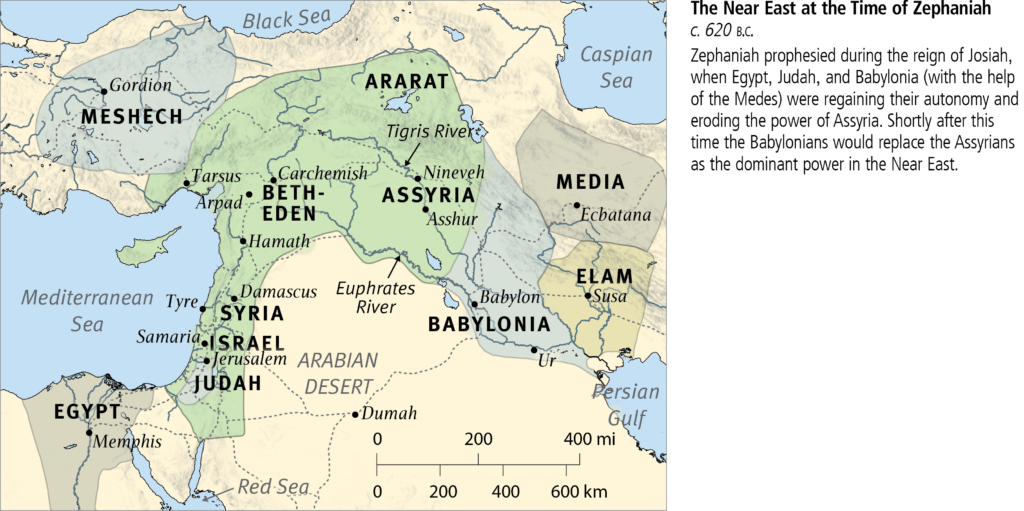
The book is set against the background of numerous nations, many of which opposed God through opposition to his people, Israel. The Philistines (Zeph. 2:4–7) had been vying against Israel for the same land since the time of the conquest (e.g., Ex. 13:17; Josh. 13:2), while Moab and Ammon (Zeph. 2:8–11), distant relatives of the Israelites (Gen. 19:36–38), had opposed Israel’s passage through their land before the conquest (Numbers 22–24). “Cush” (Zeph. 2:12) possibly refers to the Egyptian Twenty-fifth (Ethiopian) Dynasty (see Isaiah 18), while Assyria (Zeph. 2:13–15) is the foreign power controlling Judah at the time of the prophecy. Surprisingly, the last among the nations being warned is represented by Jerusalem, the capital of another of God’s enemies, Judah (Zeph. 3:1–7). This places the message of God’s displeasure right in the face of those who claimed to be his own people.
God visits judgment on his own people to purge the faithless from their number. At the same time, he preserves the faithful and will use them to bring knowledge of God to all peoples. On the great day of judgment, God will purge the faithless from all mankind and bring the faithful into their full inheritance.
Taken from the ESV® Study Bible (The Holy Bible, English Standard Version®), copyright ©2008 by Crossway, a publishing ministry of Good News Publishers. Used by permission. All rights reserved. For more information on how to cite this material, see permissions information here.
Taken from the ESV® Study Bible (The Holy Bible, English Standard Version®), copyright ©2008 by Crossway, a publishing ministry of Good News Publishers. Used by permission. All rights reserved. For more information on how to cite this material, see permissions information here.
Difficulty: 2/5
Substantial exposition for conscientious readers.
Difficulty: 3/5
Substantial theological analysis and exposition for knowledgable readers.