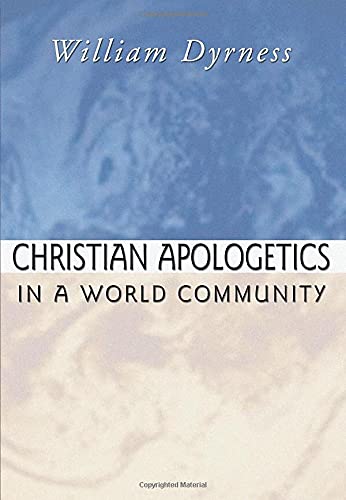
The author’s aims in writing this book are (a) to respond to the philosophical presuppositions of world views opposed to the Christian one, and (b) to help the reader develop an apologetic position. He does not aim to answer specific questions, but he assesses various positions to encourage the reader to make up his or her own mind. He succeeds admirably in reaching his goals. The book is written in a popular style, aiming to help especially those who do not have a formal philosophical education. It will therefore prove a useful tool for those readers who want to begin to get to grips with world views opposed to the Christian faith. Though expressly written for a North American readership, it will be relevant to Western European readers also.
The book is divided into two sections. The first aims to provide an introduction to apologetics, including a defence of its usefulness. There then follows a historical survey of the use of apologetics in the history of the church. Dr Dyrness sets out the issues clearly and simply.
The second section is perhaps more substantial in content. The author, the current President of New College, Berkeley, seeks to provide a framework for meeting specific challenges to Christianity, including those of Eastern religious philosophies (chapters five and six), the empirical and social sciences (chapters seven and eight), the problem of evil (chapter nine) and Marxism (chapter ten)—and all that in less than 200 pages! This section is a helpful, concise and clear introduction to these minefields which nevertheless have to be traversed by the serious, thinking Christian. Given the author’s background in Asia, the section on syncretism is especially helpful.
There are nevertheless some weaknesses in the work. Some sections are understandably but frustratingly short. More space especially could have been given to the biblical basis for apologetics (only two pages), which some would want to challenge. Again, a more critical approach to some issues would have been appreciated, e.g. Aquinas (pp. 33–35), who has done immeasurable harm to the church, escapes too lightly in the author’s critique of his thought. Moreover, a number of readers may be unhappy with his analysis of the question of what happens to those who have never heard the gospel (especially p. 109): ‘… We should leave open the possibility that judgment will be relative to knowledge and to obedience (Rom. 2:12–15), and that some may find grace by throwing themselves on God’s mercy insofar as they know it. We cannot exclude the possibility that God’s mercy is mediated through the fallen creation …’. But surely Romans 3 and 10:13–17 demonstrate that faith comes only through hearing, and establish the need for preachers to be sent with the Word. If we allow any other means of the message of salvation coming to the individual, inevitably important conclusions about the nature of mission will follow. However, these reservations refer only to small sections of an otherwise carefully written, graciously argued and recommended book.