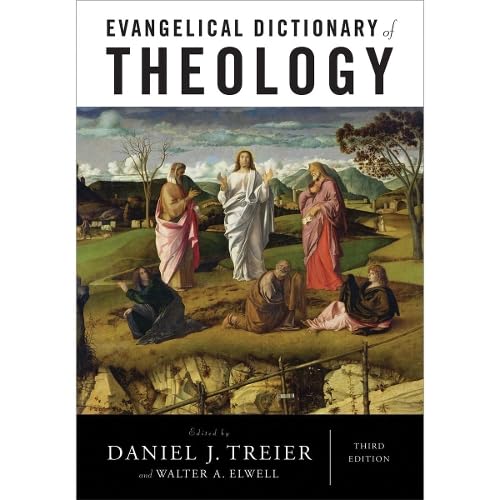
Handsomely laid out and bound, the Evangelical Dictionary of Theology contains 1,200 entries in 1,200 pages of text prepared by 200 scholars from North America, Britain and the Commonwealth. The articles, which deal with a wide range of theological concepts, movements and documents as well as philosophers and theologians, were purposely written in popular language with emphasis on clear communication. According to the editor, ‘Our goal was this: that the scholar find it correct; the layman, understandable’ (p. v). If this statement suggests that the Dictionary might be lacking in substance, the reader need not worry. The articles are in fact remarkably comprehensive, substantive and informative, even to the theological specialist.
Whereas the reviewer discovered an article on ‘Halloween’ (!), he searched in vain for entries on anhypostasia, doctrinal development, indigenous theology, Marxism/communism, patristics and Socinianism (a short paragraph was found under ‘Unitarianism’). On the other hand, the reader may well be surprised at the wide range of topics treated which are not normally found in similar dictionaries of theology, e.g. ‘Ageing, Christian View of’, ‘Alcohol, Drinking of’, ‘Asian Theology’, ‘Gospel, Social Implications of’, ‘Marital Separation’, etc. Likewise one discovers a wide range of churchmen and theologians treated, such as P. Althaus, W. Ames, D. Sayers, K. Schwenckfeld and J. H. Thornwell. Among the outstanding longer articles one might mention ‘Atonement, Theories of the’ by L. Morris; ‘Christianity and Culture’ by W. Dyrness; ‘God, Attributes of’ by G. Lewis (note the fresh approach); and ‘Theodicy’ by J. Feinberg.
The reviewer was struck by the consistent quality and style of the articles in the Dictionary. For this praise is due to the editor and the publisher. Moreover, the scholarship reflected in the articles is uniformly impressive. A helpful bibliography of literature in the English language and cross entries to connect up with related material in the volume are given at the end of each article. An index of names, as in the Westminster Dictionary of Christian Theology, would have assisted the reader to consult all discussion in the volume related to a given personality.
In sum, the Evangelical Dictionary of Theology must be viewed as the definitive theological dictionary from an evangelical standpoint. It sets the standard for subsequent works to aim at. Here is a reference tool that ought without question to be on the shelf of every university student, seminarian and Christian worker.