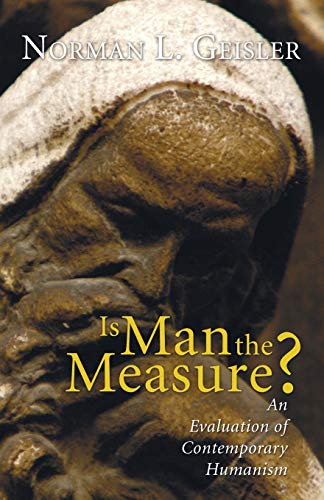
Professor Geisler has given us a useful primer on contemporary humanism. There are two sections. The first is an exposition of eight different versions of humanism: evolutionary, behavioural, existential, pragmatic, Marxist, egocentric, cultural, and Christian. Such names as Huxley, Sartre, Corliss Lamont, and C. S. Lewis are included. In the second section these forms of humanism are evaluated in terms of their positive contributions and their shortcomings.
The expositions are brief, relatively comprehensive, and well footnoted, at least to the major works of the authors cited. The treatments are fair. The tool most used in his analysis is ruthless logic. For example, on behavioural humanism, B. F. Skinner is quoted as pointing out that ‘man himself may be controlled by his environment, but it is an environment which is almost wholly of man’s own making’ (p. 33). Thus man is what man has made of man. Geisler evaluates this claim (that man is completely determined) and finds it self-defeating (p. 36). According to Skinner, both determinists and non-determinists are behaviourally determined to believe what they believe. Yet Skinner is writing to try to convince non-determinists that they are wrong, and that as reasonable men they ought to accept his arguments. Yet Skinner denies this very kind of freedom! Further, (p. 36), he points out a serious inconsistency in Skinner’s position. Skinner claims that man is completely determined and not free, yet he (Skinner) exhorts man to change his environment. Obviously this falls between two stools. If man is completely determined by his own environment he cannot determine that environment. This kind of logical evaluation is used on every view cited, including Christian humanism.
Perhaps the weakness of this kind of treatment is that it fails to sense the emotional tug that makes each position attractive. It would have been helpful for Geisler to include a ‘Sitz im Leben’ for the development of these modern humanisms, because, as he presents them, it would seem that only less than logical, less than brilliant, minds could hold them, which is obviously not true.
The absence of empathy is most clear in some of his discussions of C. S. Lewis, where Geisler proceeds with this kind of logic. Lewis denies many Old Testament miracles (p. 105), yet accepts the deity of Christ. But, according to Geisler, it is Christ who verified the historicity and authenticity of some of the Old Testament events Lewis rejects, such as the literal truth of Jonah, the creation of Adam and Eve, and Noah’s flood. He chides Lewis for using a humanistic base in his reading of the Old Testament using the category of myth. He sees this as a logical inconsistency in Lewis. Yet Lewis could have argued, as others have, that Jesus’ reference to Jonah was merely to refer to the story as existing as literature and not necessarily a reference to that story as literal truth. Perhaps in a longer treatment Geisler would have dealt with this possible reply.
Many readers will be familiar with Geisler as a participant in recent creation versus evolution trials in the United States. One sees the impact of that experience in the running attack on evolutionist thought in most of the book. For instance, on page 107, he notes that Lewis also held an evolutionary view of the universe, as an illustration of how Lewis came under the negative influence of secular thought. Obviously, that is an arguable assertion and illustrates a bias with which each point of view is discussed.
There is a helpful section on the various versions of the Humanist Manifesto and other ‘secular humanist’ documents with evaluations, again using a very strict logic. It is pleasing to see honest facing up to the many good contributions of secular humanism to our common culture (p. 129). ‘In brief, this world is not only freer because of Humanism, it is more beautiful, more advanced scientifically, and more variegated culturally.’
Most impressive is his attack on secular humanism at its very core, that is, its supposed scientific content. Geisler does this by a brief treatment of the essential elements of scientific practice. On the basis of these quite broadly accepted characteristics of science he then evaluates the naturalistic view, an amazingly good treatment in a very brief span—almost as good as that chapter in Lewis’ volume Miracles. However, it is done in the context of an evolutionist versus creationist debate. I don’t think that is particularly helpful.
His final judgment is: ‘In either event, secular Humanism is not sufficiently rational’ (p. 175). This is a damning judgment. I believe he supports this judgment quite adequately, even though his treatments are brief.