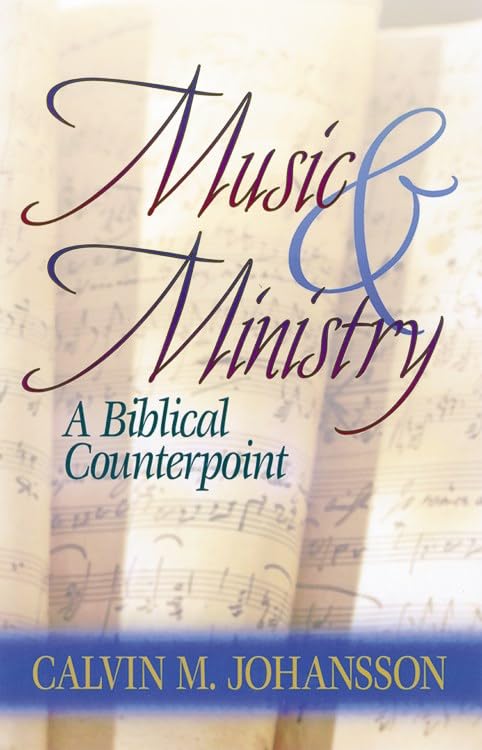
Reading this book has been an interesting challenge. Each time I opened it, I have found myself resonating deeply with the author’s sentiments one minute, and hotly disputing his arguments the next. Perhaps the key lies in the subtitle, for counterpoint in music is all about the independence, yet interdependence of two or more contrasting melodic lines.
Johansson’s main theme is that, in order to fully reflect God’s image in humankind and the church, music directors should lead congregations towards the finest music of which they are capable. An excellent ideal, and one with which many will concur. The problem lies in Johansson’s outright condemnation of what he broadly terms ‘pop’ music, which is often expressed in bombastic and vitriolic statements that suggest he has little in-depth experience of the music he is describing.
He begins with two philosophical perspectives on music—aestheticism and pragmatism—suggesting that neither is a suitable foundation on which to build a music ministry. He goes on to outline the Biblical doctrines of Creation, Imago Dei, Incarnation, Faith and Stewardship, allocating a chapter to each, and drawing out their implications for church music.
He rightly reasons that our creativity is a reflection of our being made in the image of the Creator God, and that his image is therefore evident throughout the arts. Since, as Christians, we reflect God’s image to the world, our choice of musical material will affect the accuracy of the image we portray. He suggests that contemporary society is based on ‘the four pillars of relativism, hedonism, selfism and materialism’, and that since these characteristics are in direct contrast to the Gospel of Christ, then the music deriving from this culture ‘gives a distorted view of the gospel’.
Part of the difficulty I had with the book is the author’s unwillingness to define the music he is talking about in concrete terms. He refers frequently to music that is ‘trite, banal, uncreative’ without offering any examples, and hedges round a definition of creative music by suggesting that music ministers will intuitively know what is good and bad. The best ones will, but it would have been useful to hear Johansson’s view.
He devotes a whole chapter to a rigorous attack on pop music, which he defines as ‘made distinctly for widespread acceptance’. ‘Worship is the last place music of immediate gratification should be used.’ Whilst we would readily acknowledge that the commercialism and instant satisfaction characteristics of the music industry sit uncomfortably alongside gospel characteristics, to write off a whole range of musical styles because of the way they are handled in the world seems at best unwise, and at worst, arrogant. Statements like ‘artistic integrity is incompatible with popularistic appeal’ instantly dismiss the bulk of Classical and Baroque repertoire, whilst his assertion that ‘to entertain … is to wile away the time in frivolous activity, bypassing the mind’ is ludicrous. One may watch a Shakespeare play to be entertained, but few would call it frivolous. His underlying point is that church music should not entertain, but he dismisses the argument that music that is effective in drawing non-Christians is permissible, without offering an alternative.
However, the overall theme of the book is highly positive, encouraging music leaders to develop a programme that enables their congregations to worship with the very best and in so doing to glimpse a little more of the mystery of God incarnate. He sets high ideals, and would have been more convincing if he had been able to show how these had been achieved in his 40 years as a church music director. Each reader will draw their own conclusions regarding musical style, but all will be challenged to think deeply about their philosophy of music ministry.